In the first part, I told you how Move and I prepared for the European Open in Portugal: the 3,000-kilometer drive, the heat strategy and the mental preparation, which had a very different meaning for me this year. If you haven't read it yet, here's part one: The European Open 2025, Part 1: How Move and I Prepared for Portugal. Now it's about the competition itself: the team competition, the individual runs and a silver medal that stayed on my mind more than I'd expected.
At the ring, the pressure many people know kicked in: I can't fail now. But as soon as I entered the ring with Move, it disappeared. Suddenly we were on the same wavelength, as if we'd never done anything else. Today I know that this was exactly the state I describe in Flow in Agility. We started with a clean run that initially put our team in 4th place, and I had felt it: we've got what it takes when it counts.
After that first really good run, all my nerves were gone for the remaining runs, simply because after that success I had complete trust in our skills. In the second team run, the agility run, I was already much more relaxed, knew the course, trusted my handling decisions and, above all, trusted Move. The result was one of Move's best runs ever, with speed, confidence and a natural ease that made the handling easy. The less I concentrated on my nerves and the more I focused on what I could control, my handling, my lines, my communication with Move, the better we ran.
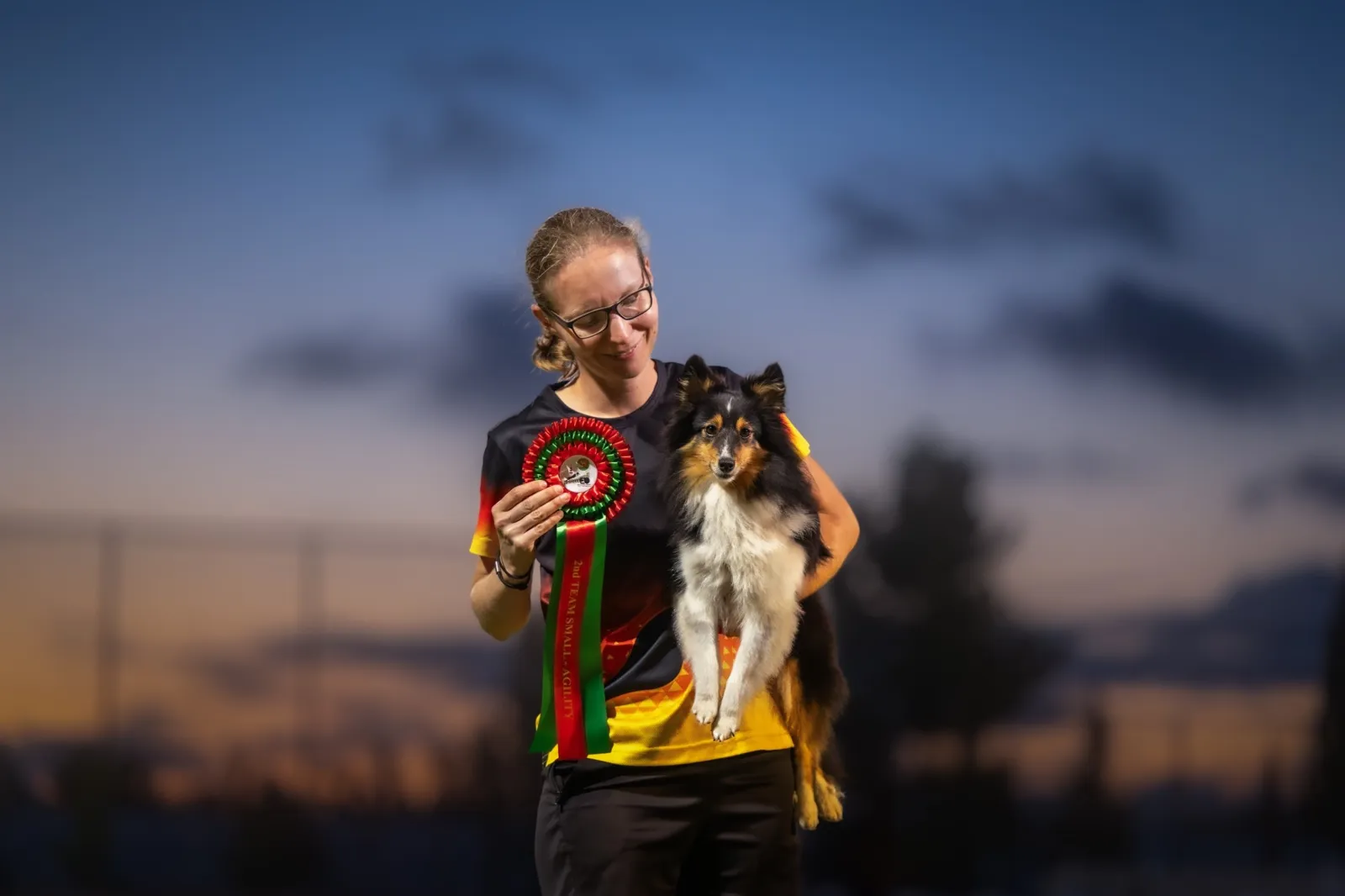
At the end of the team competition, there was a silver medal. In the final, we were the last team to run, and Move was the very last dog on course. If my teammates run clean, in the end it all comes down to me. While the previous team member was running, I had to decide in a split second: take the risk of a false start to get into position faster and save time, or play it safe so as not to risk a disqualification. I waited until the other dog was far enough away and only then ran to my starting point. We ran clean. All four team members, zero faults. 2nd place.
What I was almost even prouder of than the result: Move stayed at the start, despite the enormous pressure in that moment and despite sensing that something big was in the air. A year ago, that wouldn't have been a given at this point. Staying calmly down in exactly that moment was the result of months of targeted training, not luck.
Five things from this experience have stuck with me, and they apply to every competition, not just the EO. Prepare mentally, but trust your skills in the ring: nerves before a run are normal, but once you're in the ring, you switch to what you've trained, and your training routine is your mental anchor. A good first run relaxes you for the rest of the competition, the confidence builds like a snowball effect. Focus on what you can control: not on how others run or how hard the course is, but on your handling, your lines, your communication with your dog. Trust is contagious: your dog senses whether you're doubting or confident. And allow yourself that first success: consciously take a moment to realize that the two of you did something well, because this small acknowledgment boosts your confidence for the next runs.
In the individual runs, I experienced what anyone who has ever narrowly missed a final knows. In jumping, Move slipped slightly, caught the outside jump, and the bar only came half down. In agility, it was a slip off the seesaw. Both times would easily have been enough for the final.
My first reaction was brief disappointment. My second reaction was a huge grin, because I realized something crucial: Move had done 98 percent perfectly in both runs. Speed, confidence, turns, simply everything was right. The remaining 2 percent, a slippery moment, a bar, weren't training mistakes. That's sport. Instead of being frustrated, I was prouder than ever, because for the first time I really understood that we can make it on our own. The times had shown it: Move is one of the fastest small dogs in the world.
In the past, after runs like these, I would probably have brooded over the mistakes, asked myself what I'd done wrong, turned my training completely upside down and focused on the 2 percent that went wrong. Today I focus on the 98 percent that were fantastic. I analyze the mistakes, but I celebrate the successes, because the dog senses what you're focusing on. If you only see the negative after a run, that rubs off. If you appreciate the 98 percent of greatness and write off the 2 percent as part of the game, your dog stays motivated and confident.
Four principles follow from this. Distinguish between system errors and bad luck: wrong handling, poor timing or unclear cues belong in training, while slipping despite perfect execution or a falling bar despite a correct jump are part of the sport. Celebrate the 98 percent, analyze the 2 percent: after every run, first ask what worked fantastically, usually most of it, and only then what can be optimized next time, usually very little. Your reaction shapes your dog: if you get frustrated after a mistake, you teach your dog that mistakes are bad, and if you stay relaxed, you teach your dog to simply try again. And use mistakes as a motivation boost, because top 10 times despite small slip-ups show what's possible in principle.
The difference between outcome focus and process focus is what really makes the difference here. “We have to make the final” is outcome focus. “I want to run the best possible lines and support Move as well as I can” is process focus. At the EO, I consistently thought in terms of process and asked myself after every run whether I had made the right handling decisions and had been as readable as possible for Move. The result followed automatically.
After the EO, I could have turned my entire training upside down. Instead, I asked myself what the only two situations were in which Move didn't perform as usual, and how exactly these situations could be recreated in training.
The first situation was the seesaw. Move slipped off when the tension became too much to hold: our first seesaw fault ever in competition. Watching the video, it became clear why: I was standing right next to Move instead of in front as usual or already running on. Seeing me there made the tension hard to handle, and a small twitch from me was enough for the slip. My new seesaw training is correspondingly simple: once a week, I send Move onto the seesaw and deliberately stay standing beside the seesaw instead of running on. What I want to see is still the normal, confident seesaw, and only then do I run on.
The second situation concerned the start in the general runs outside of the final: Move was more excited than usual overall and didn't always stay down as reliably at the start, so I had to make two or three corrections before the release. At normal competitions that's not a problem, but at the EO the atmosphere, the other dogs and the tension were more intense. Testing boundaries when excited is normal for Move, but I want a reliable wait even in exciting situations, especially for future team competitions. My new start training: deliberately building up even more tension and energy before the start to make it even more solid. I also show you this in the Startline Bootcamp course.
Why less was more here: I'm not working on the seesaw in general, but on the seesaw when I'm standing next to it. That only takes a few extra minutes of training per week instead of hours of restructuring, means little stress for the dog, because to the dog it feels like a new, fun variation rather than a problem, and leads to quick success. After a few weeks, neither situation was an issue anymore.
You can apply this to your own training: don't ask whether your contact is bad in general, but in which specific situation it didn't work. Instead of ten new exercises, practice the one situation that didn't go well. And keep in mind that a mistake in competition doesn't mean your overall training is bad, often it's just one specific situation that hasn't been practiced yet.
Move and I became Vice European Open Champions, a silver medal at the EO. And yet my first thought was: silver is the first loser.
When Move didn't make the final in the individual runs, I was quickly motivated and proud again after a brief moment of disappointment. With the silver medal, the feeling was more complicated. With a clear failure, the situation is clear-cut: bar down, bad luck, keep going. But with a success that narrowly misses the dream, everything is more complex. Behind this is what's known as negativity bias: our brain perceives negative events about five times more intensely than positive ones, which made sense in evolutionary terms, because our ancestors who recognized dangers quickly were the ones who survived. For us today, that means even with a huge success, the brain automatically focuses on what wasn't perfect. Instead of the fantastic silver medal, my thoughts kept circling around the one to two seconds between gold and silver, and whether I could have been the one to tip the balance.
After a few weeks of distance, I realized: this ambivalent feeling isn't just normal, it's valuable. It shows that you're ready to grow, because anyone who focuses only on the result they've achieved stops learning. It doesn't mean you're ungrateful, you can be proud of silver and motivated for gold at the same time. And it's the drive for the future, this almost-made-it feeling is one of the strongest motivators there is.
It's not about being either satisfied or hungry, but about being able to be both and actively working against negativity bias. The 5:1 rule helps with that: since the brain weighs negative aspects five times more heavily, you have to consciously collect five positive aspects for every negative one. For me, it looked like this: one negative thought, “it could maybe have been gold,” against five positive ones: Vice European Open Champion, something 99.9 percent of all agility teams never achieve. Move's team was the second-best small team in the world that weekend. We showed that we can deliver under pressure. I've grown as a handler and gained confidence in myself. And we were able to show that we're world class. Suddenly it becomes clear how overwhelmingly positive the experience actually was.
Five strategies have proven helpful for dealing with these almost-made-it moments:
The best thing about dogs is that after the team final, Move was simply happy: a perfect run, lots of celebrating and rewards, and from the dog's point of view everything was perfect. Move reminded me that the journey is the destination. The connection between us, the perfect moments in the ring, the trust we've built: that's what counts. The medal is nice. But this experience, this growth, these lessons are priceless.
To this day, the moment at the start of the team final is a small symbol for me of what a year of targeted training makes possible. If your own start doesn't hold up under pressure the way you'd like yet, if your dog gets over-aroused, breaks the start too early or tests the boundaries exactly when it counts, the Startline Bootcamp course is where I rebuilt exactly that with Move.
I used to see success as binary: either perfect or not good enough. Today I understand: every success that makes you grow and keeps you hungry is a perfect success, even if it doesn't look like the original dream.
Move and I came out of this EO stronger than we went in. We now know what's possible. And we have a silver medal that reminds us every day: we belong here. Next year we'll go for it again, more experienced, hungrier, knowing that sometimes all that lies between silver and gold is one brave moment.
I have been running agility for 23 years and have been passing on my knowledge to other teams for 16 years. I studied psychology and e-learning, which is why my articles don't just explain what, but also why.
More about me →In the course library you will find the right training plan step by step, with video instructions and real corrections.