There are runs you remember differently.
Maybe they weren't even your best. You weren't clean, your dog wasn't spectacular. What stays is a feeling. You didn't think, didn't calculate the next obstacle. You weren't aware of anything except what was right in front of you. Time shifted, passed more slowly or just differently. And somewhere between start and finish you were no longer a handler with a plan, but a team that simply ran.
If you've experienced something like that, you know what I'm talking about. If not, you'll recognize it as soon as it happens.
The word for it is flow.
The concept was described in the 1970s by the Hungarian-American psychologist Mihály Csíkszentmihályi, after decades of research into what makes people truly immerse themselves in what they do: artists, surgeons, athletes, musicians. He called it optimal experience, a state of complete, effortless absorption in which performance feels natural, time changes and self-doubt disappears.
Three conditions lie behind it: The level of difficulty has to match your level of skill. Too easy and you're bored, too hard and you're anxious. Flow lives in the narrow space in between, where what's asked of you sits right at the edge of what you can do. Add to that clear goals: You need to know what “good” looks like in that moment. And immediate feedback, you need to be able to tell in real time whether things are working.
Agility naturally meets all three when the conditions are right. The course is clear. The feedback is immediate. And when you and your dog are calibrated, when the challenge is real but achievable, the zone opens.
Flow is more than a feeling. It has a neurochemical signature. During flow, the brain releases a cocktail of chemicals: dopamine for focus and pattern recognition, norepinephrine for alertness, anandamide, which lifts your mood and dampens fear responses, plus serotonin and endorphins.
More interesting than what gets released is what stops happening. Neuroscientist Arne Dietrich describes the effect of flow on the prefrontal cortex as “transient hypofrontality”: a temporary reduction of activity in the brain region responsible for self-monitoring, time perception and inner criticism. When it quiets down, you stop second-guessing yourself. You lose track of time. The inner critic goes silent.
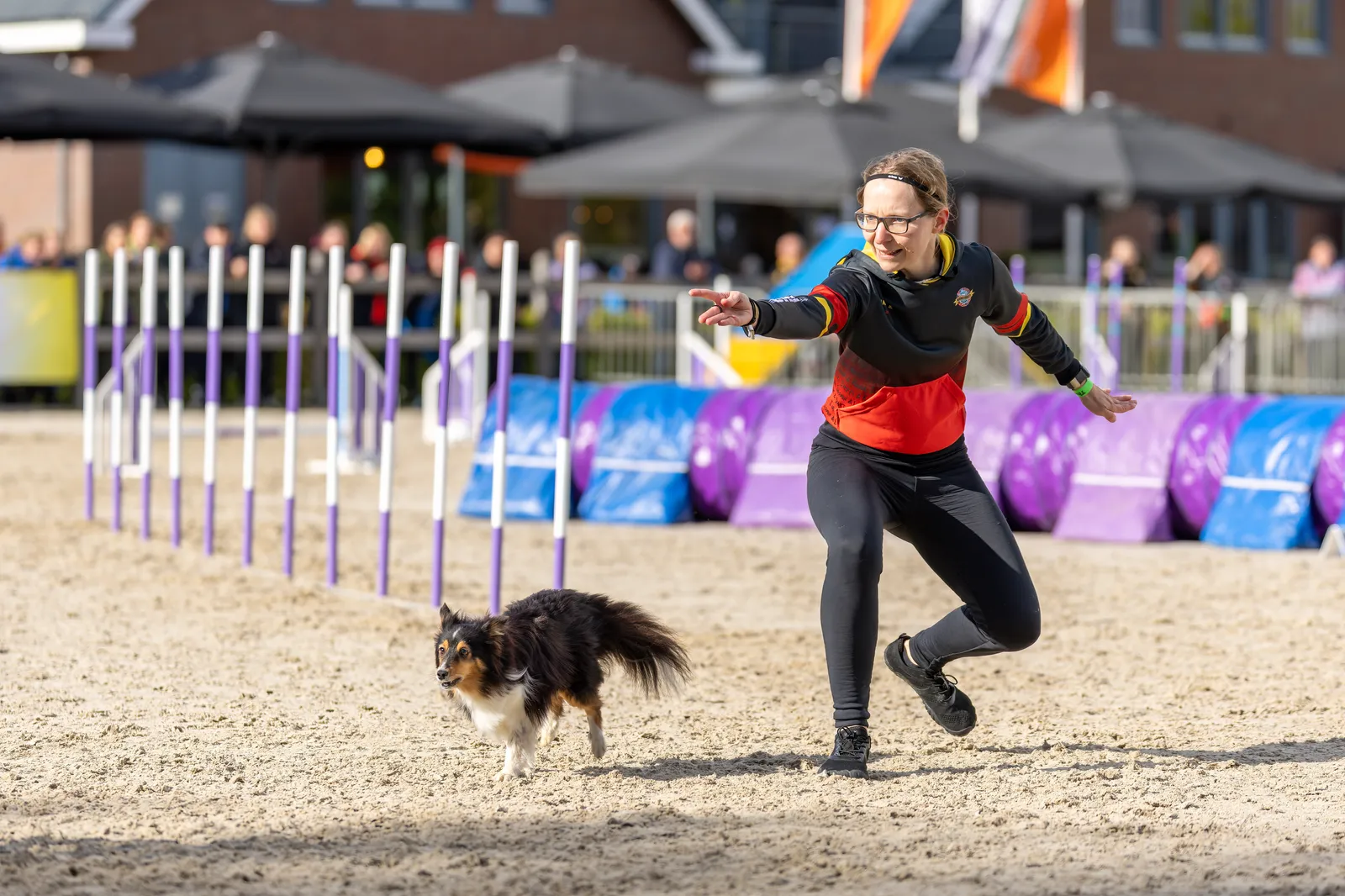
By now I recognize this pattern in myself. When a run is going really well, I feel calm and very alert at the same time, present down to the last detail, without it feeling like effort. Time changes, the run feels slow and strangely detailed at once. And I stop thinking. Handling decisions happen before I consciously make them. I felt this most clearly in the team competition at the European Open 2025. I talk about it in Part 2 of my EO recap.
Two things destroy this state. On the one hand, a mistake pulls me out, because the prefrontal cortex wakes right back up. On the other hand, I drop out as soon as I start thinking about the result, whether we'll qualify, whether the run was good enough. The zone closes immediately. The mistake itself is almost never the problem. What makes it a flow breaker is the thinking afterwards.
We don't have measurements from inside a dog's head in the middle of a competition. But we know from animal behavior research that dogs experience the same basic reward chemicals we do: dopamine, endorphins, oxytocin. And the conditions for maximum engagement in animals are remarkably similar to Csíkszentmihályi's model: challenge matched to ability, clear context, immediate feedback.
In competition, this means my dog Move reads my handling before I've fully given the cue. If I'm half a beat late with a turning cue, Move is already there. If I'm slightly out of position, Move adjusts before I do and reads the whole picture faster than my hands can give the cues.
You can recognize this state by your dog no longer looking for confirmation. It trusts the momentum. What usually destroys it is the same as with us: a sudden interruption of the familiar pattern, a loss of trust, or simply too much handling. Extra cues become noise in these moments. Sometimes the best thing you can do is get out of the way and let your dog run.
Create the conditions, invite the state, done: described like that, it sounds almost too simple. Before all of that comes a prerequisite most handlers don't see.
Move is a Sheltie: small, fast, athletic, the kind of dog that should naturally have tight, economical turns. For years, Move didn't. I had taught collection exactly the way I taught my other dogs, same exercises, same cues. The others turned tight. Move understood what I wanted and still ran wide arcs that cost time on technical sections.
What I didn't realize back then: Move was in stage 3, disguised as stage 4.
You might already know the model behind this from my article Knowing vs. Doing: Every skill goes through four stages, from unconscious incompetence through conscious incompetence and conscious competence to unconscious competence. Stage 3 means the dog can do it when the conditions are right: low pressure, familiar surroundings, enough attention. The skill works, but it takes active processing. Only stage 4 is truly automatic, effortless, in any context, under any pressure.
Move's turns held up as long as the conditions were easy enough. As soon as arousal was high or the sequence got complex, they fell apart. Only when Move was four years old did it really come together. What made the difference wasn't more repetitions, I had long since done more than enough of those. What made the difference was an approach that was completely black and white for Move, with no room for a slightly wider interpretation.
That's the connection to flow: It needs cognitive capacity. If a skill still requires conscious processing, that is exactly what blocks the capacity that would need to be free for the zone to open. Automation is a fixed part of the prerequisites, even if hardly anyone thinks of it first when they hear the word flow.
The day before the World Championship qualifiers, Move had a training session after a break due to injury: happy and enthusiastic, but running with excitement instead of focus. Obstacle discrimination sequences that were normally perfect fell apart. Again and again, Move disappeared into the tunnel, too wound up to follow the cue.
I kept going. I wanted to end on a good note before stopping. The session ended with exactly the feeling you need least before something important: uncertainty. I took that feeling with me into the qualifiers. I avoided the skill for the entire competition, even though Move could have done it. What was missing in that moment was my own confidence, which I had undermined myself at exactly the wrong time.
The last session before a competition should stay short and familiar. Sequences the two of you have done a thousand times. These days I end it as soon as it feels good, no matter whether my mental checklist is completely ticked off. The problem skill can wait until Monday.
Create conditions where the challenge sits at the edge of what your dog can currently do, with clear goals and immediate feedback. Ask yourself honestly whether a skill is really stage 4 or just stage 3 in the right context, and what moves it from one to the other is often a different training approach, not more repetitions. And treat the last session before an important event as what it is: confidence building, not a test.
You can't decide to be in flow. What you can influence are the conditions beforehand: whether a skill is truly automatic, whether the last session before the start built confidence, whether the challenge in the ring matches what you can do together. Structure and automation lay the foundation. The trust between you and your dog builds on top of it.
If you're still at the point where skills like turns or changes of direction are more stage 3 than stage 4, it's worth taking a look at Left & Right. The course builds Hard Turns, tight directional cues at the jump, from the ground up, exactly the kind of foundation that can become automatic later on.
The next run where you stop thinking and simply run starts long before the start signal. It starts with the work you do in training this week.
I have been running agility for 23 years and have been passing on my knowledge to other teams for 16 years. I studied psychology and e-learning, which is why my articles don't just explain what, but also why.
More about me →In the course library you will find the right training plan step by step, with video instructions and real corrections.