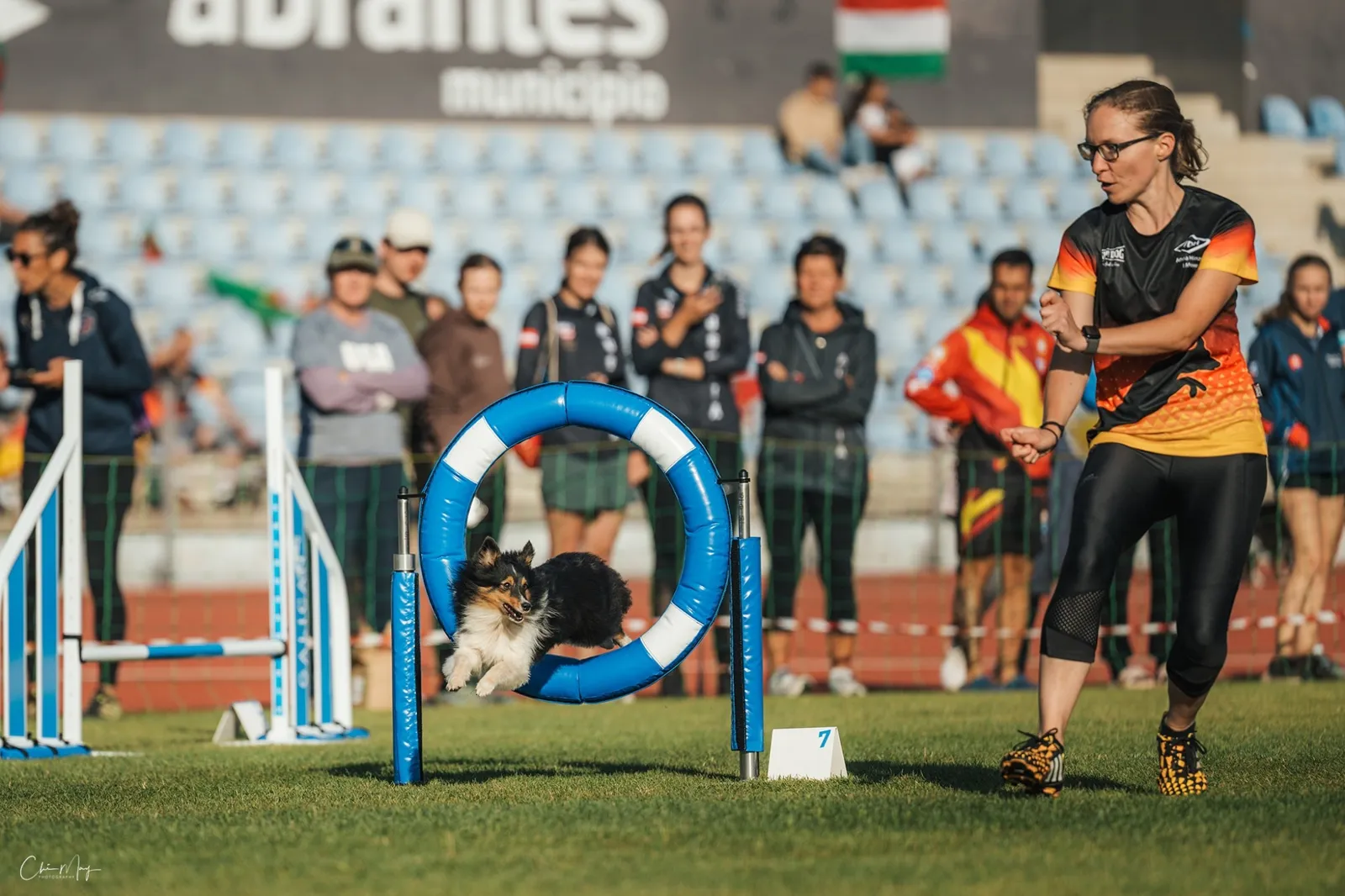
In mid-July, Move and I drove 3,000 kilometers to Portugal to compete at the European Open, one of the most important agility events in the world. Move had qualified for the German team as one of only eight small dogs. Before I tell you how the competition itself went, I want to start with the preparation, because in the end it decided at least as much as the runs themselves.
Mid-July in Portugal, outdoors on natural grass: it got hot. Really hot. The organizers had thought things through: air-conditioned cooling tents for the dogs, several pools to cool off in and an adjusted schedule with a 6 a.m. start and a break during the hottest hours. My takeaway: you can make these kinds of adjustments in your own training too. Training early in the morning or in the evening makes a huge difference in summer.
For the drive itself, 28 to 30 hours in a motorhome that heats up quickly, I had worked out a three-step strategy. Shade management: silver sun sails stretched over the motorhome, plus window fans for better ventilation at night. Dog-specific gear: shade coats made of the same silver material, which you can wet and which keep the dogs cool continuously. And training under real conditions: we had been practicing on natural grass in the sun for weeks, with the result that Move wasn't bothered by the temperatures at all and ran just as focused as always.
Three things from this preparation have really stuck with me. First: getting used to conditions beats perfection. Instead of only training in perfect conditions, we deliberately tested different surfaces and temperatures, and that made Move more adaptable. Second: preparation gives you confidence. Every little detail I plan in advance takes stress off me on site, and less stress for me means a more relaxed dog. And third: the journey is part of the goal. The 3,000-kilometer drive wasn't a necessary evil, it was part of the adventure.
In the days before the start, a different story kept running through my mind. In 2019, I became European Champion in the team event with my Border Collie May, one of the most emotional moments of my agility career. What I didn't know back then: it was one of May's last big competitions. After Covid, May never came back to the sport and passed away in early 2025. This experience changed my entire approach to mental preparation: from focusing on placings, times and comparisons with others to focusing on what I can actually control.
To set myself realistic goals, I first had to understand the format. The EO consists of two competitions. In the team competition, there are two qualifying runs, after which the qualified teams battle it out on one huge final course, with four teams starting from four different corners, almost like a relay, where tactics matter just as much as speed. The individual competition also has an agility and a jumping qualifier, followed by a final where everything starts from zero: one run decides the podium. Pure pressure.
With that understanding, I set goals that I could influence myself. In the team: deliver solid runs, together with Daniel Schröder, Silas Boogk and Maurice Münch, whose collective strengths really come into play in the team format. In the individual: make the final and give it my best there, knowing full well that Move, being a small dog, isn't the fastest, but that a clean run can still take us far. Goals outside my control, like placings, create stress. Goals I can influence myself give me strength.
Alongside the mental preparation, in the weeks before the EO we also worked specifically on one very concrete skill: obstacle discrimination. On an international course that neither Move nor I had seen before, it isn't enough for Move to recognize an obstacle when I'm standing right in front of it. Move also has to head for it confidently when two options are close together and the decision is really up to the dog. That's exactly what we invested a lot of time in during the weeks before Portugal, and this training paid off again and again at the EO.
My mental preparation was built on three pillars. No experiments before the event: in the last week of training, I polished familiar exercises, start, seesaw, dogwalk, and didn't try out any new skills or tinker with problem skills. Creating mental movies: from the moment I leave the course walk, I visualize my run and play it back again and again, every movement, every cue, to get into the focus zone before I'm even standing at the start. And keeping perspective, with the mantra: it's just agility, I'm taking the best dog home. One mistake doesn't define the whole experience, and we're already enjoying the trip, the atmosphere, the adventure.
The most important lesson from May was never how to win. May showed me that every run is a gift, that the connection between dog and human matters more than any placing, and that true strength doesn't mean never making a mistake, but being grateful for every moment you get to spend on the field together.
In the second part, I'll tell you how things actually went in Portugal, from the team competition and the individual runs with their supposed mistakes to a silver medal that stayed on my mind more than I'd expected: The European Open 2025, Part 2: What Silver Taught Me About Pressure, Mistakes and Success.
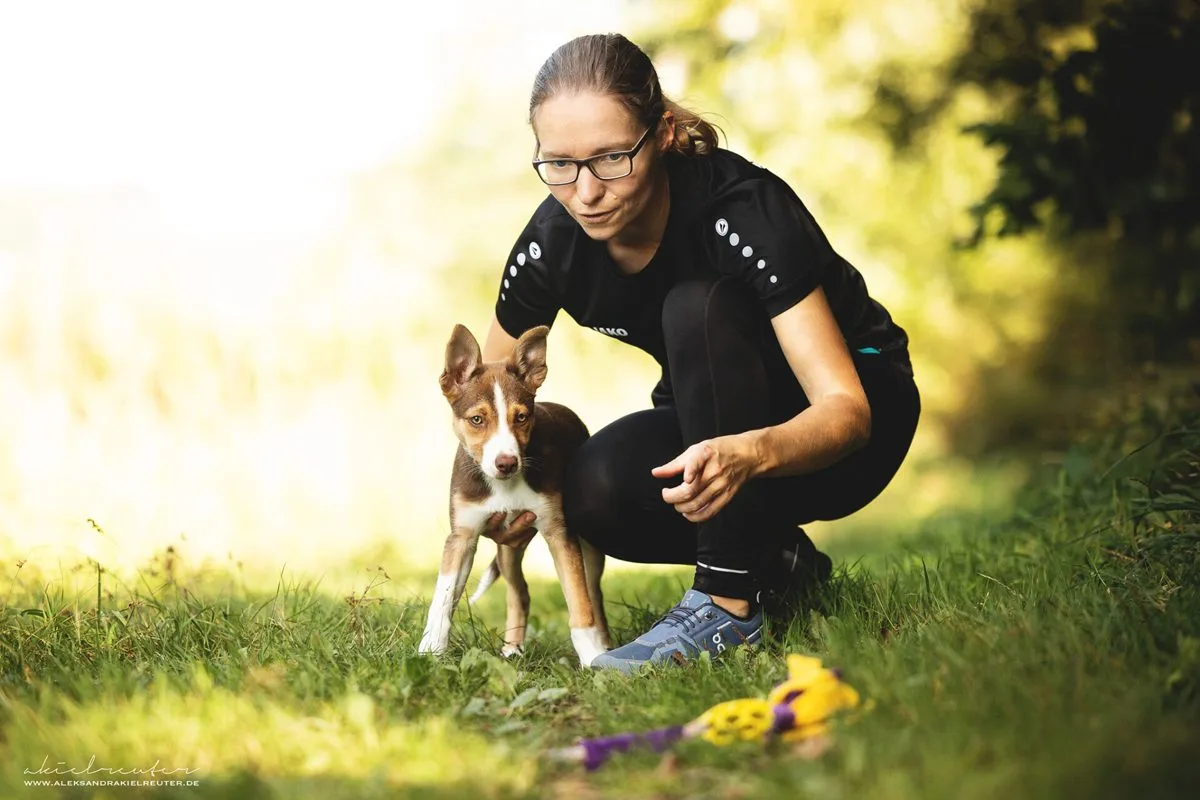
I have been running agility for 23 years and have been passing on my knowledge to other teams for 16 years. I studied psychology and e-learning, which is why my articles don't just explain what, but also why.
More about me →In the course library you will find the right training plan step by step, with video instructions and real corrections.