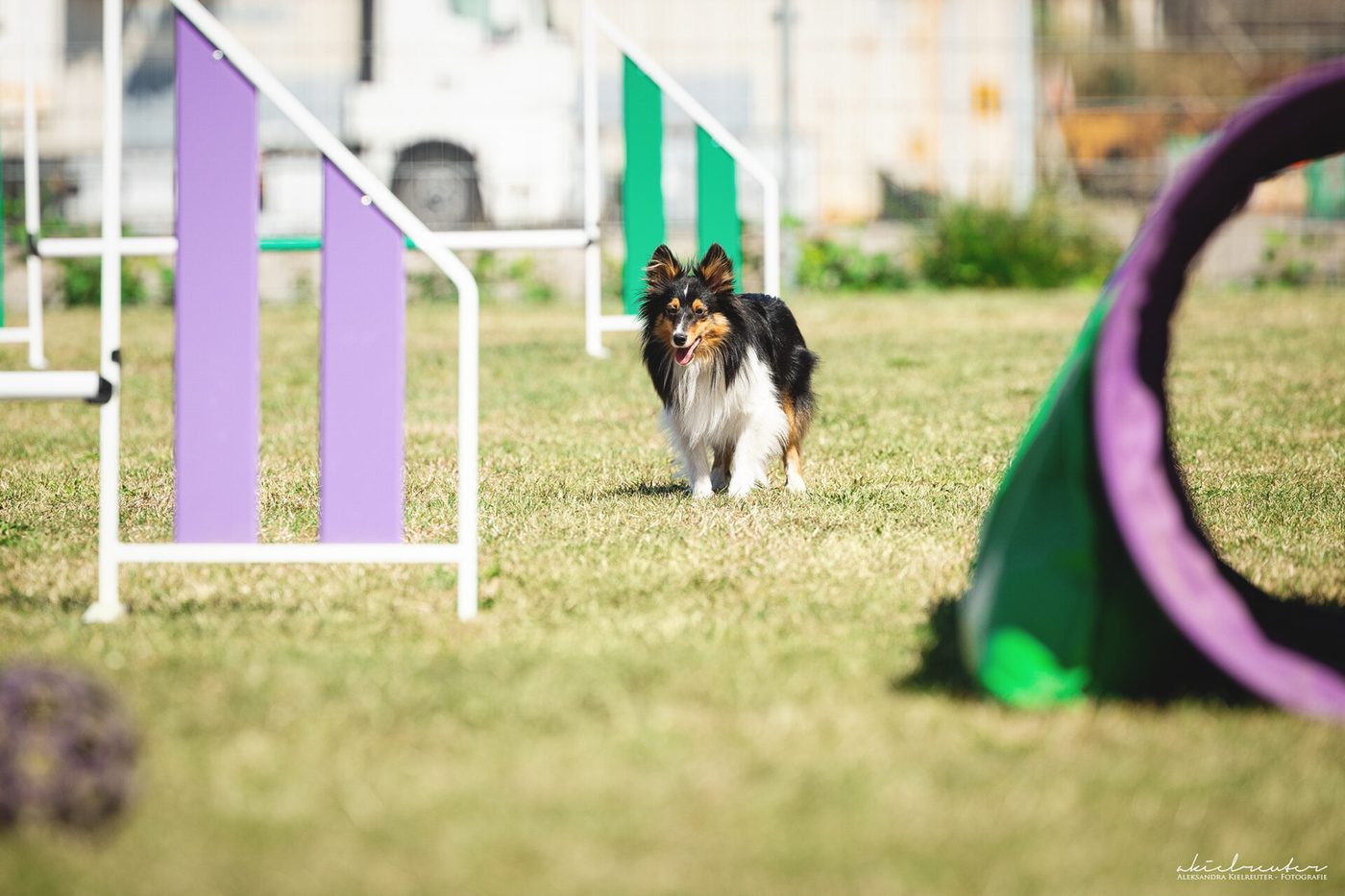
Agility has changed rapidly in the last five years. In the past, a strong handler with a medium-fast dog could still run everything and get through clean. Today, depending on the course and the judge, that is much less often possible. Sequences have to be handled at a distance, and a new way of training integrates distance work and obstacle focus right from the start.
It is by no means only the highest class that is shaped by this. We also find significantly more distance elements in A1 and A2. Jumps, tunnels and the dogwalk are in the handler’s path, and the dogs have to take the obstacles without the handler. For dogs that have learned to read the line themselves, this is rarely a problem: the lines follow a logic. This type of course suits fast dogs with good obstacle focus very well.
Experienced, older dogs with little obstacle focus. In the past, these teams could usually run everything together. On modern courses, that often no longer works. Distance training and obstacle focus were usually not part of these dogs’ basic training. That would have to be retrained. And retraining is always harder than building it up from the start. Especially when a team has been getting through courses without these skills for five or more years, it becomes hard to shift the focus, established over years, from the handler to the obstacle.
Beginner teams with classic training based on luring. In the past, you could start with less thought-out training, switch later and still be successful. Today, teams that have lured their dogs through the course with a piece of sausage for too long have a much harder time in the higher classes.
The consequence is structured training with an emphasis on obstacle focus, distance exercises and understanding verbal cues, ideally from the very beginning. These are exactly the three building blocks I work through with you step by step in the course Obstacle Focus & Distance. But the two groups above can improve too. The steps just need to be small, and your own expectations adapted to your dog’s learning history. A dog that has been accompanied to every obstacle for four years will not turn into one that takes obstacles at a six-meter distance overnight.
In my training, I teach concepts that can later be transferred to the equipment. Most of these concepts can be built up without equipment in a small space. Once a dog has understood the basics, the transfer to the equipment is much easier. So you can do this without your own course.
Since no equipment is needed, most of the concepts are not physically demanding. So in theory, you can start with very young dogs. Your dog should have the mental maturity to concentrate on a task for a little while. I show you how to build that concentration in small steps in The One-Minute Revolution. An understanding of rewards and a stay position are helpful, and some impulse control should be there. Find out here why impulse control matters so much.
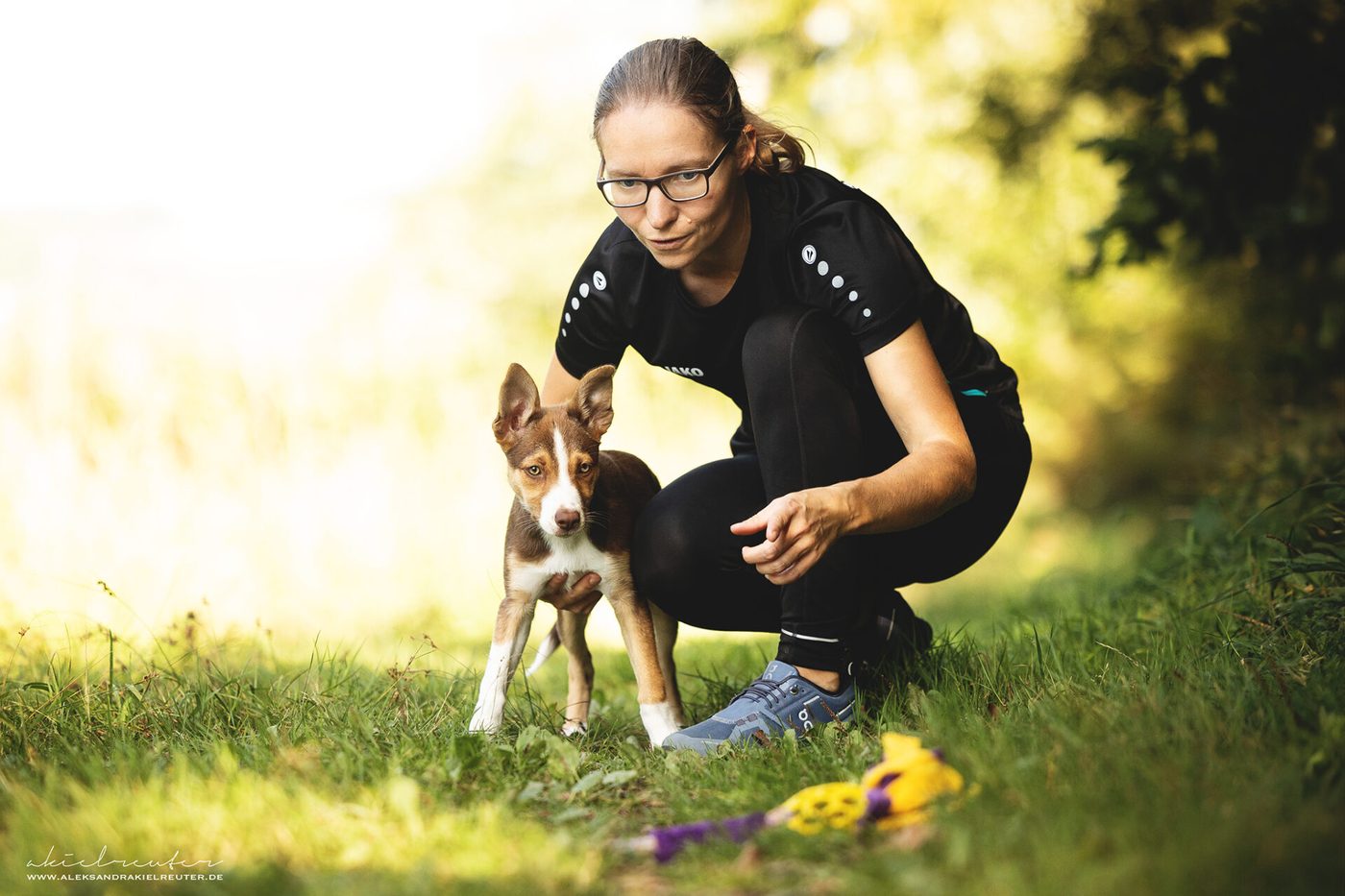
Obstacle focus can be started beautifully as a focus on a reward. The goal: on a cue (for example “focus”), your dog looks at a reward but does not run to it. It stays in its waiting position. A food machine works well for this, but so does a bowl guarded by a helper.
Your dog should know the reward and have drive towards it. In the beginning, you hold your dog by the harness and only let go when it looks at the reward or pulls towards it. If it pulls very hard, hold on until it gives in for a moment. If you say the focus cue when your dog looks but does not pull, and let go exactly then, it connects the two.
After a few repetitions, you add a stay position: sit, down or stand. Now your dog should hold the position despite the focus cue and only start on a release cue. A very short moment is enough in the beginning, so release quickly. But don’t reward a broken stay.
It is actually good if broken stays happen in the beginning and don’t lead to success because the reward is taken away. This way your dog builds an understanding of holding position and focus. Bit by bit, you extend the interval.
Once the cue is solid, you can transfer it to a toy reward. By then, though, your dog should hardly make any mistakes. We can’t control this reward, and too many corrections affect the drive towards the toy.
In the next step, you transfer the cue to an object. With young dogs, I like to use a dog bed that the dog already knows and drives towards without being asked, because it has often been rewarded there. In the beginning, there is still a cookie on it for the dog to focus on. Then I leave out the reward and, after the focus, send the dog there with the cue for the bed. This way, “focus on a reward” becomes “focus on an object”.
The more objects and obstacles your dog gets to know, the more options you have. Once it learns the tunnel, the focus can be transferred to it as soon as the tunnel is understood as an obstacle and your dog drives towards it. The same goes for jump cues and all other obstacles.
Important: your dog must have understood its job on the obstacle well before we connect the obstacle to the focus cue. A dog that still turns around in the tunnel should first understand the tunnel.
Once your dog has understood that the focus cue means looking at an obstacle, you can move further and further out to the side. This way, even a young dog can focus on a tunnel on the other side of the dogwalk while you stand ten to fifteen meters to the side. It gets used early on to doing a task on its own instead of being accompanied to every obstacle.
When building distance work, it matters where the reward is. The reward belongs on your dog’s line and not in your hand, otherwise you reward coming in to you instead of working at a distance. A thrown reward is often not ideal either, because many dogs start looking around. Your timing then has to be very good.
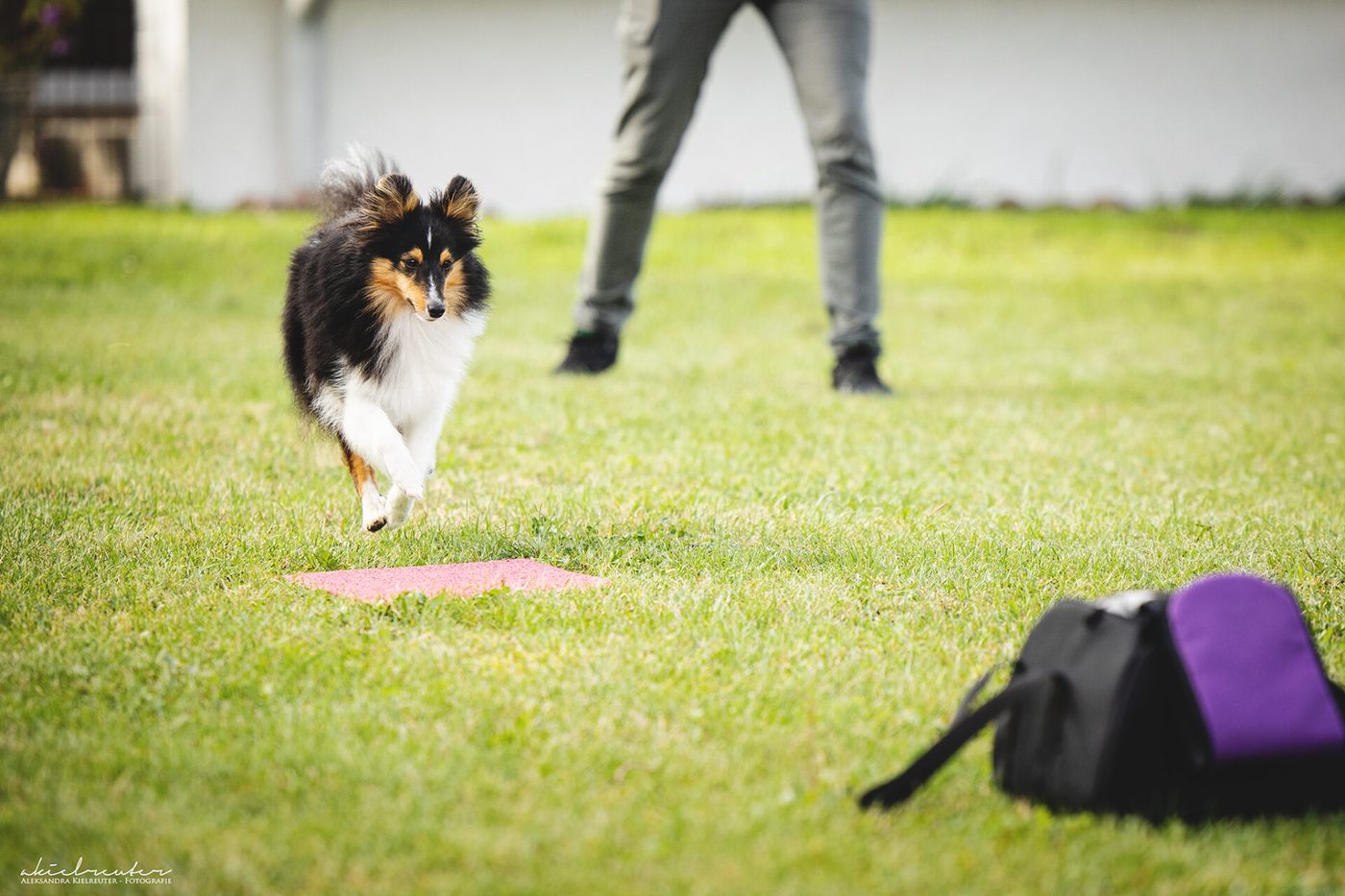
This, too, can be built up well in a small space. I use two cues that the dog knows reliably without hand signals, for example sit and a spin. Now your dog should tell them apart by the word alone. If that doesn’t work yet, first practice both separately on the verbal cue.
This cue discrimination can be extended to everything your dog should learn purely verbally. If it understands the concept in a small space, it will later be easier to transfer it to obstacle discrimination on the course, independent of your body language.
Dogs communicate largely through body language and therefore pay much more attention to it than to our words. If we give a verbal cue and a physical cue at the same time (for example, luring with the cookie in a circle), the dog always perceives the physical one more strongly. That’s why: first the verbal cue, then the hand signal. This way your dog understands the word as an announcement and will eventually anticipate the hand signal.
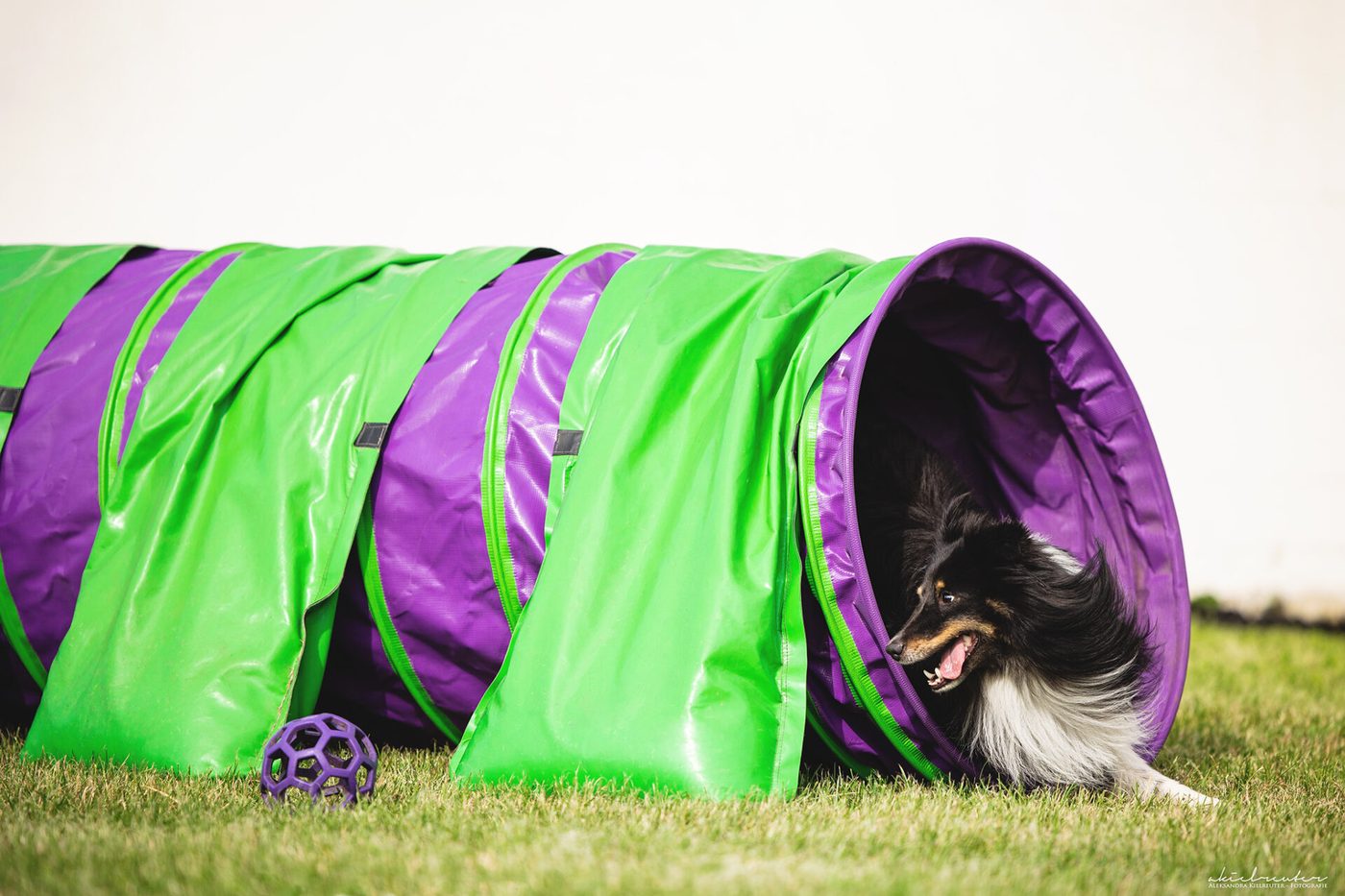
Once good obstacle focus and confidence on the obstacle are built up, distance work is no longer rocket science. As so often, the basics have to be right before the skills are trained on the course. A dog that is only lured into the distance with a laid-out reward will find this much harder.
I have been running agility for 23 years and have been passing on my knowledge to other teams for 16 years. I studied psychology and e-learning, which is why my articles don't just explain what, but also why.
More about me →In the course library you will find the right training plan step by step, with video instructions and real corrections.