You're standing on the training field. Your dog is sniffing. At the fence, in the grass, at the spot where something fascinating apparently happened ten minutes ago. You call your dog. Nothing. You show it a toy. A quick glance, then back to nose on the ground. You feel like the most boring person on the planet while your dog is exploring the most exciting version of the world.
Most handlers want more focus in that moment. This question is more worthwhile: What if, for now, the goal is just one minute?
This article is about a principle that is usually only applied to behavior in training, even though it works just as well for connection: shaping. On top of that comes a second, counterintuitive tool that works well alongside it: boredom.
You're probably familiar with shaping. You don't teach a dog a complete course on day one. You start with one jump. Then two jumps. Then a jump and a tunnel. Small approximations toward a big goal.
A relationship can be shaped in the same way, even if many people overlook that.
A dog that stays focused and connected with you in highly distracting environments is like a complete course. If your dog can't give you that right now, the foundation is simply still missing. You build it like any other behavior: from the bottom up, in small steps.
The most common mistake here is overestimating the starting level. Handlers often expect their dog to concentrate for ten minutes, because that's what they themselves need to feel successful in training. In that moment, though, your dog may only be able to give you thirty seconds before the environment pulls it away again. That says nothing about its character, only something about the actual starting point. Shaping means: start exactly there.
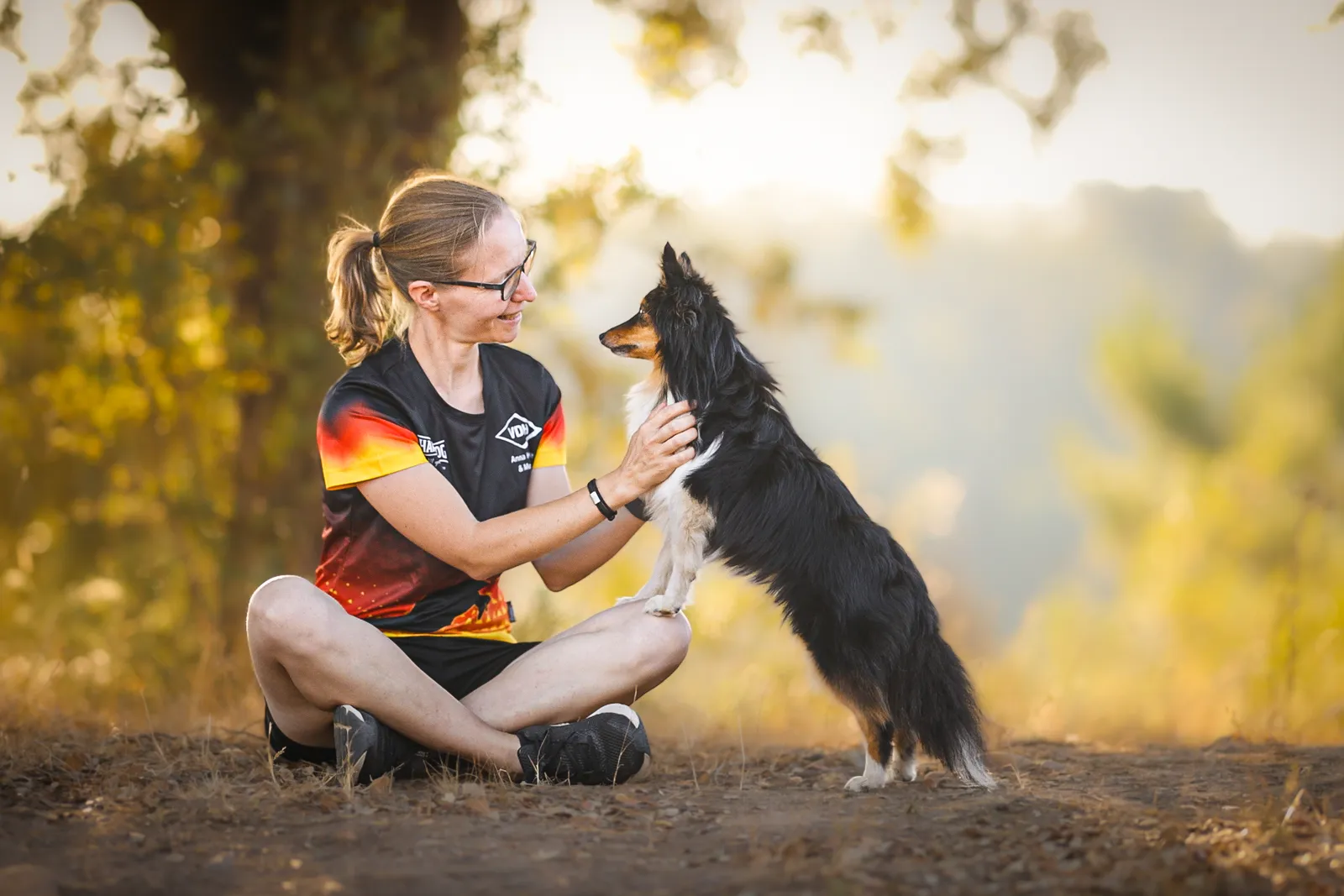
Here's what that looks like: a timer, one minute, maximum reinforcement. That one minute isn't about precision or clean exercises, it's about becoming the most interesting thing in the room for your dog. Over-the-top joyful, with treats or a toy, with a real celebration for every small moment of engagement.
When the timer goes off, you stop. Even if your dog is right in the middle of it and you could easily keep going.
That feels wrong at first. You end on a high while your dog still wants more. That's exactly what makes the next session valuable: the environment itself becomes a signal for “something good is about to happen here with my person.”
After about a week, something usually changes. Your dog starts to anticipate and already checks in when you arrive. Only then does the duration go up: from one minute to two, then three, then five, in small steps. The mistake is always the same: expecting too much too soon.
Once these foundations are in place, you can later direct the focus specifically onto obstacles. I show you how I build that in a separate article: The Focus Cue.
Most training advice tells you to be more interesting than the environment. Louder, faster, more exciting. That works as long as your dog doesn't run into a world that is simply infinitely more interesting than any person with a treat in hand. One counterintuitive tool helps in exactly those moments: making the environment itself less interesting.
Behind this is a simple principle from learning psychology: habituation. A repeated stimulus loses its significance over time. On your first day in a new apartment, you notice every sound, every play of light on the wall. A year later, your brain barely registers any of it.
The same mechanism is at work on walks. A new environment stays fascinating for your dog because something is constantly changing. The same route every day, with the same trees and the same smells, on the other hand, gradually loses its appeal. Once the environment becomes predictable, the person at the other end of the leash becomes more important.
In practice, that means: a short, quiet route, ten to fifteen minutes, exactly the same every day. No fighting the sniffing, just let your dog walk. After one to two weeks, the first small check-ins appear, quick glances asking what you're up to. Mark and reward these moments. Only once they come regularly do short engagement games move into the route: a game of tug, a quick trick, a little recall game. With this habit in your toolbox, you then head out to new, more distracting places.
For some dogs this process takes weeks, for others months. That's the usual time frame for a connection that holds up under distraction.
Let's say you've done both: the one-minute sessions and the boring walks. Your dog reliably checks in with you and chooses you over the environment again and again. Then you drive to a new training field or to a competition, and suddenly your dog is right back where the two of you started weeks ago.
That's down to a feature of the canine brain: dogs are poor generalizers.
That explains a lot of frustrating situations: the dog that shines in training and disappears at competitions, that's focused indoors and loses its head outdoors. The reason rarely lies in motivation or in the relationship itself. Your dog simply hasn't gotten to know this new context yet.
The same principle applies where strong instincts come into play, for example a pronounced herding drive that can completely pull a dog out of the connection next to a busy competition ring. The same approach helps here too: find a distance where your dog can still think, and slowly work your way closer from there. That's a separate, bigger topic in its own right. All that matters for today: building in small, doable steps works even when genetics have a say.
A simple roadmap is enough to begin with. Choose a starting point where your dog can actually be successful. Set a timer for one minute, be the most interesting person in the room for that minute, and stop as soon as the timer goes off, even if more would be possible. Repeat this daily and only increase the duration once your dog starts checking in with you on its own. Add a fixed walking route that's always the same. It gives your dog the space to see you stand out from the environment. And as soon as this works in one place, take the same short engagement moments with you to new places, instead of only increasing the duration in the same place.
None of the techniques here are new or secret: a timer, a quiet route, a bit of patience in new places. Their effect comes from repetition over weeks, not from a single big moment. At Agility Campus, this idea comes up again and again: Train smart. Not more. Training that fits your dog's actual level achieves more than training that just adds more time on the field.
If you want to lay this foundation especially early, you'll find the structure for it in the Foundation Course. It starts right here: small steps that build on each other for puppies and young dogs, regardless of the sport you'll do later, so that connection and basic understanding can grow from the very beginning. If you're a bit further along and already have the first foundations, the Advanced Course is the next logical step, with the first obstacles but on the same basis of structure and connection. And if you have a puppy right now and want to know when which step makes sense, you'll find that in When and How Can My Puppy Start?
Start with the one minute today. The route follows this week, the new place in a few weeks. What counts is that you start where your dog really is right now.
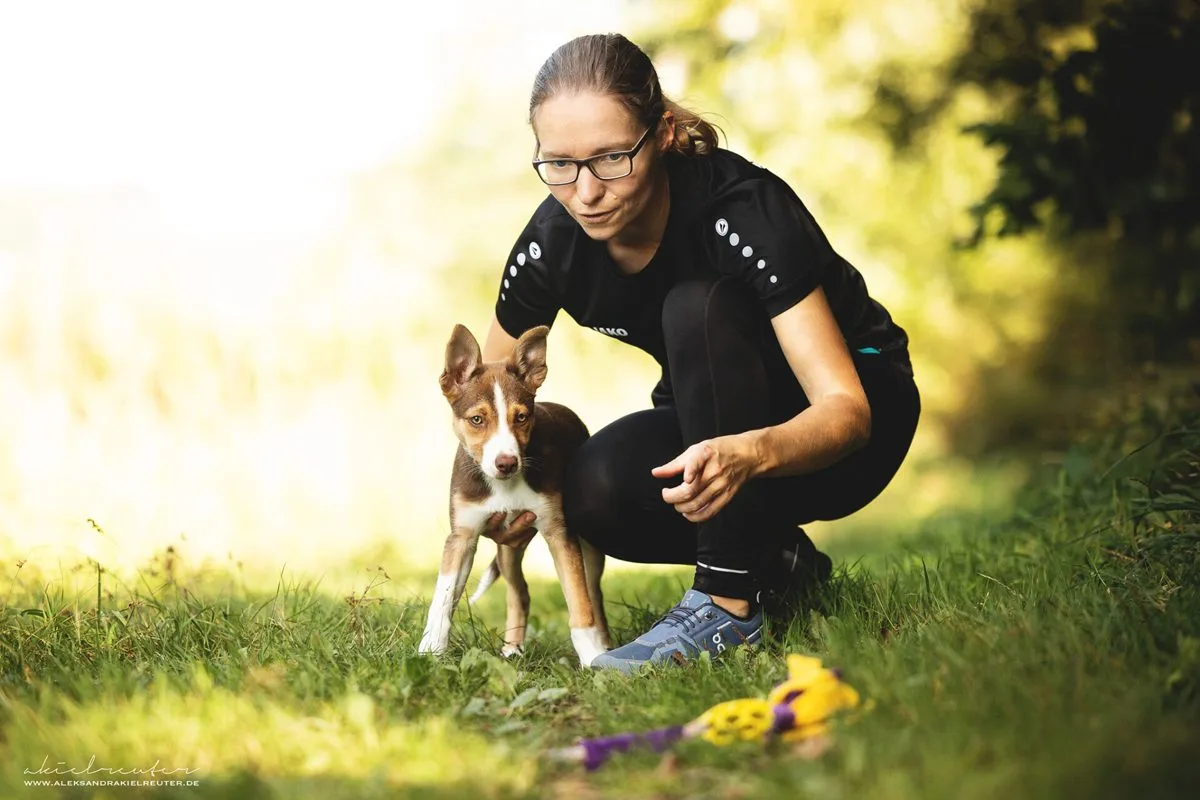
I have been running agility for 23 years and have been passing on my knowledge to other teams for 16 years. I studied psychology and e-learning, which is why my articles don't just explain what, but also why.
More about me →In the course library you will find the right training plan step by step, with video instructions and real corrections.