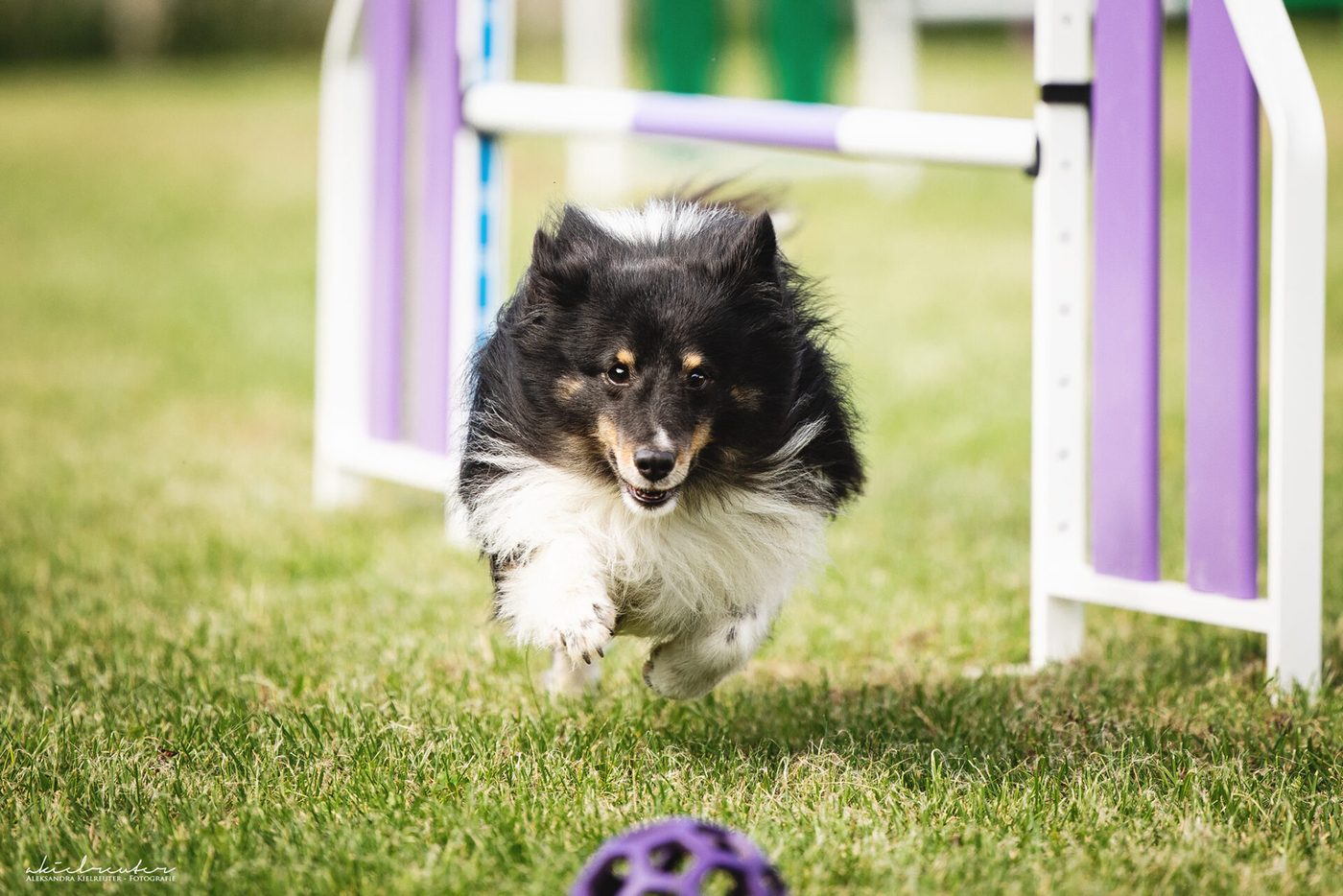
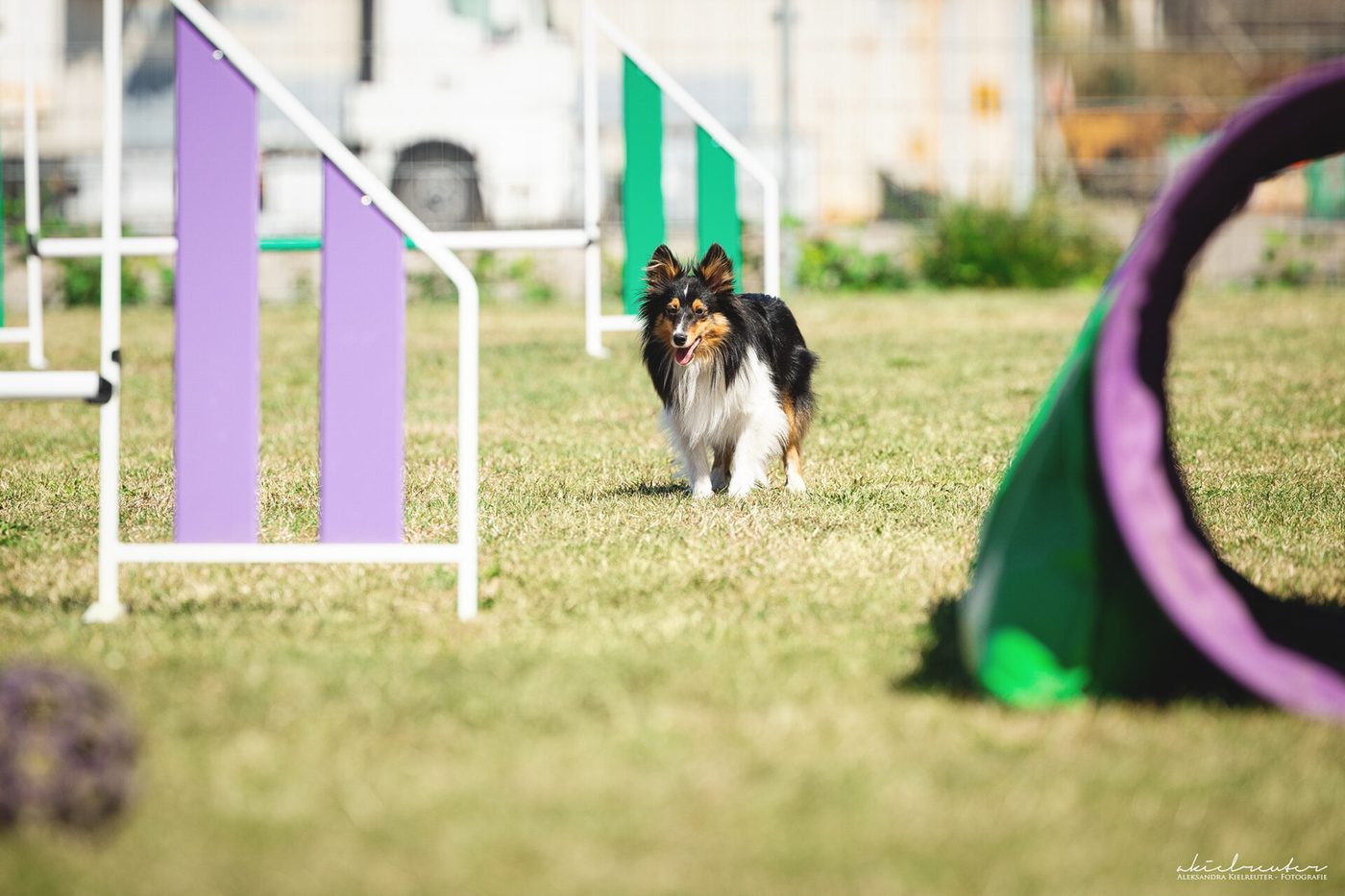
Very few agility athletes have their own course on their doorstep and therefore ideal training conditions. I know this problem very well: when I was a university student, I lived in 25 square meters, the nearest training facility was 30 minutes away, the dog sports hall 60. In my small apartment I had space for two folding jumps, which I was able to set up on a public sports field.
After moving, I had more equipment, but only a very small garden. Some of my training took place on a grassy strip two meters wide and eight meters long. With a little creativity, it still worked. Even with little space, my dogs learned many skills that turned out to be extremely useful on the big course.
Admittedly, I have ideal training opportunities today. Nevertheless, around two thirds of my own training takes place on two or three obstacles and in a small space. I would rather work on small details than run long courses.
Many of these exercises test how well your dog has really understood certain jump cues. If you discover a weak spot, make the task easier so that your dog is successful. Gradually, you can make it more difficult again.
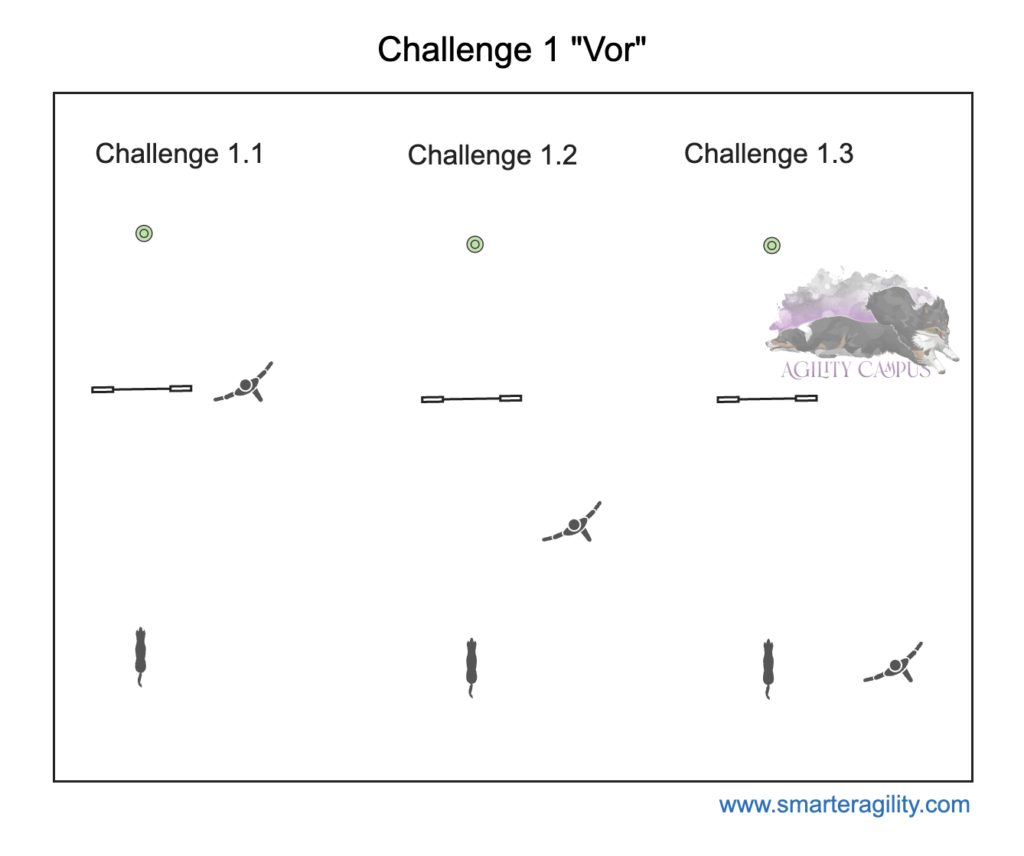
The green circle in the sketches stands for the placed reward: a toy, a food reward or a food machine. No matter which one you choose: your dog should be able to focus on it well and help itself to it independently. A clicker helps to mark the correct decision audibly.
A focus cue gives your dog extra support here. Here you can learn more about how to teach it.
This challenge is particularly suitable for young dogs or beginner dogs. But it is also relevant for more experienced dogs that don't like to move away from the handler. With the “Go On” cue, I want the dog to jump forward over the jump in extension.
1.1: On the Go On cue, your dog should jump over the jump and take the reward at the green dot. You stand next to the jump, you don't move with your dog and you don't indicate the jump with your body language. Your dog should learn to take it on the cue alone.
1.2: You gradually change your position until you are halfway between your dog and the jump. Again, you send your dog purely on the verbal cue.
1.3: Now you stand next to your dog. Does your dog also respond to the cue from this position? Then increase the distance. If you can send your dog five to seven meters without running along yourself, you have already laid a good foundation.
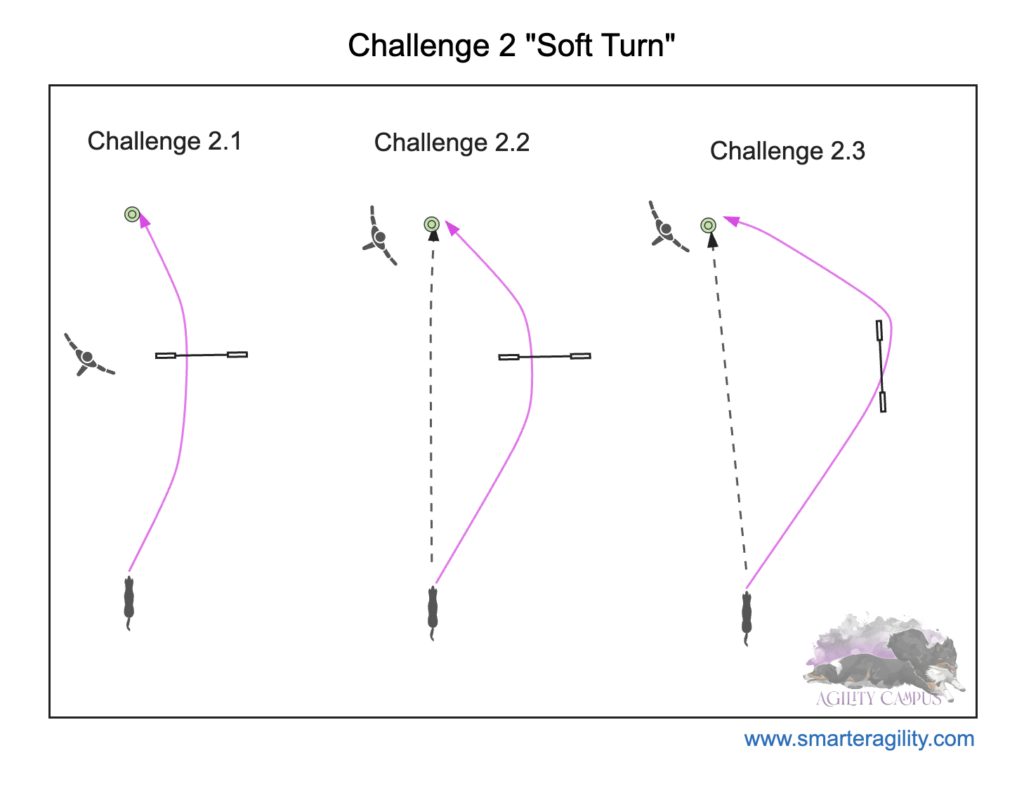
This challenge benefits all dogs that could use a little more obstacle focus. A jump cue is particularly helpful in start situations where you cannot call your dog directly in a straight line. With the jump cue, I expect the dog to take the jump and then orient itself in my direction.
2.1: Your dog sees the reward slightly offset next to the jump. The easy way there leads past the jump. If your dog chooses this route, there is no reward. You stand to the side, only give the verbal cue and don't approach the jump. Your dog must be able to run past it and actively decide to take the jump.
2.2: You keep changing your position and the starting position until your dog has to run a clear arc to the jump. The further away you are, the more worthwhile a focus cue before the release becomes.
2.3: You change the angle of the jump. The flatter it is, the more difficult it becomes for many dogs to focus on it.
Depending on how you send your dog, there may be an overlap with other jump cues. That is why the jump cue is not linked to a specific way of taking the jump. It serves to discriminate when your dog has to differentiate between two obstacles, and as an aid when handling at a distance.
For the sake of simplicity, all challenges are only shown on one handling side. Of course, you train both left and right.
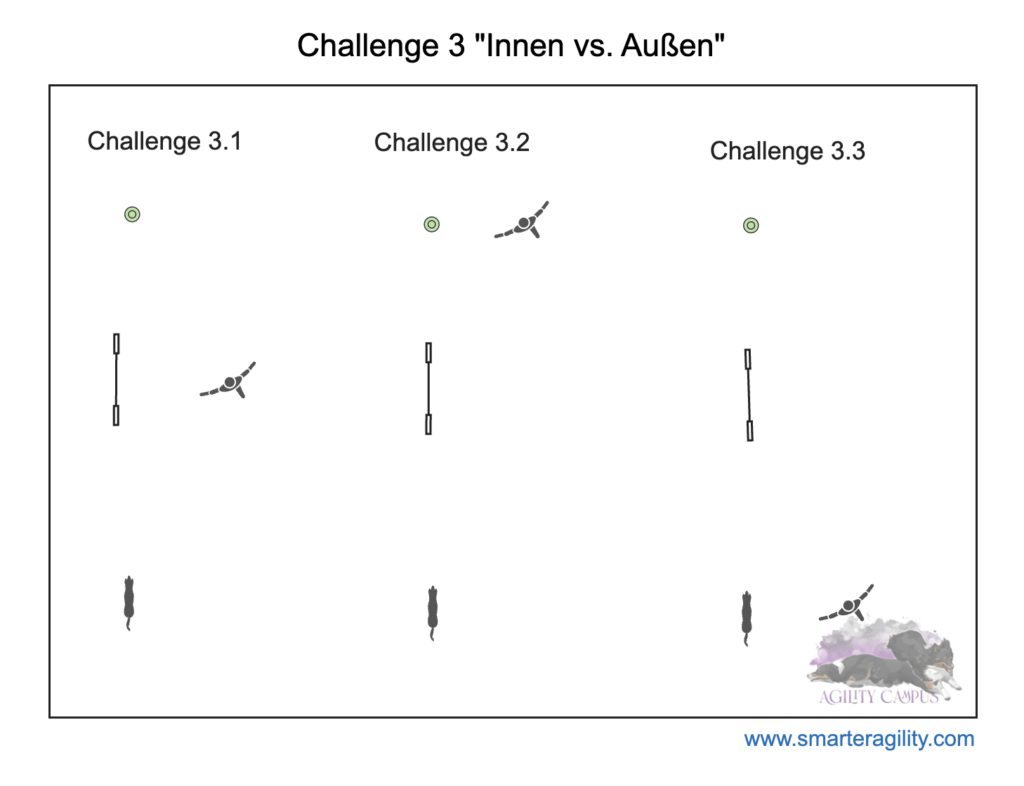
This challenge is quite difficult for many dogs, even experienced ones. In all three tasks, I alternately ask for the inside cue and the backside cue. An independent inside or backside, regardless of your position, helps when handling at a distance and whenever you are far ahead of your dog and cannot help at the jump.
3.1: You stand level with the jump. Your dog waits exactly in the middle, so it only sees the jump in profile. The reward is also placed in the middle. You ask for the jumping behavior with the cue only. If your dog makes a lot of mistakes at first, help a little with your arms: the arm pointing to the side helps with the backside, the shoulder opened to the back helps with the inside. The goal is that in the end it works without that help.
3.2: You stand in front of the jump, level with the reward. For many dogs, this position is an indicator for the inside cue. If the backside is difficult, change your position from 3.1 only gradually.
3.3: You stand next to your dog. Now the placed reward alone draws your dog forward. From this position, you can hardly give any unconscious body language cues. Your dog is on its own at the jump. That is exactly what trains independent responses to the cues.
Exercises like these not only promote your dog's understanding of its jump cues, they also demand a lot of mental capacity. So keep the sessions short: two to three minutes are often completely sufficient. It's better to train more often, but briefly. And remember to keep a balance between thinking exercises like these and drive exercises, so your dog doesn't lose motivation. You can learn more about this here.
Make sure you don't make the exercises too difficult. With static brainteasers, frustration sets in more quickly after mistakes. Reward successes generously and break up the session with play breaks. If you get stuck, take a few steps back and make it easy for your dog.
These challenges can also be practiced at a lower jump height. What matters here is listening and understanding, not physical fitness. Lower means less strain, and your dog won't tire as quickly.
You can find lots of little challenges on cue discrimination in the “This or That?” online course. It prepares you for the higher agility classes, where independent discrimination between two obstacles is required. Prerequisite: your dog knows a focus cue and can combine it with the obstacle cue. If your dog doesn't know the focus cue yet, you are better off starting with “Obstacle Focus & Distance”.
I have been running agility for 23 years and have been passing on my knowledge to other teams for 16 years. I studied psychology and e-learning, which is why my articles don't just explain what, but also why.
More about me →In the course library you will find the right training plan step by step, with video instructions and real corrections.