You've probably experienced this: your dog performs a skill perfectly at home, repetition after repetition. Then you train somewhere else, or a different obstacle happens to be nearby, and suddenly your dog hesitates in places that were never a problem before.
The first reaction of many handlers: frustration. The dog “knows how to do it”. It just showed you a minute ago.
Behind this lies a misunderstanding that explains why training sometimes stalls for weeks and why a skill that shines in training still falls apart in competition.
“Knowing” means: the dog performs the movement correctly under familiar, controlled conditions, with known setups and surroundings. “Doing” asks for more: the dog recognizes the skill in different contexts, responds flexibly to changes, and the skill still works under pressure.
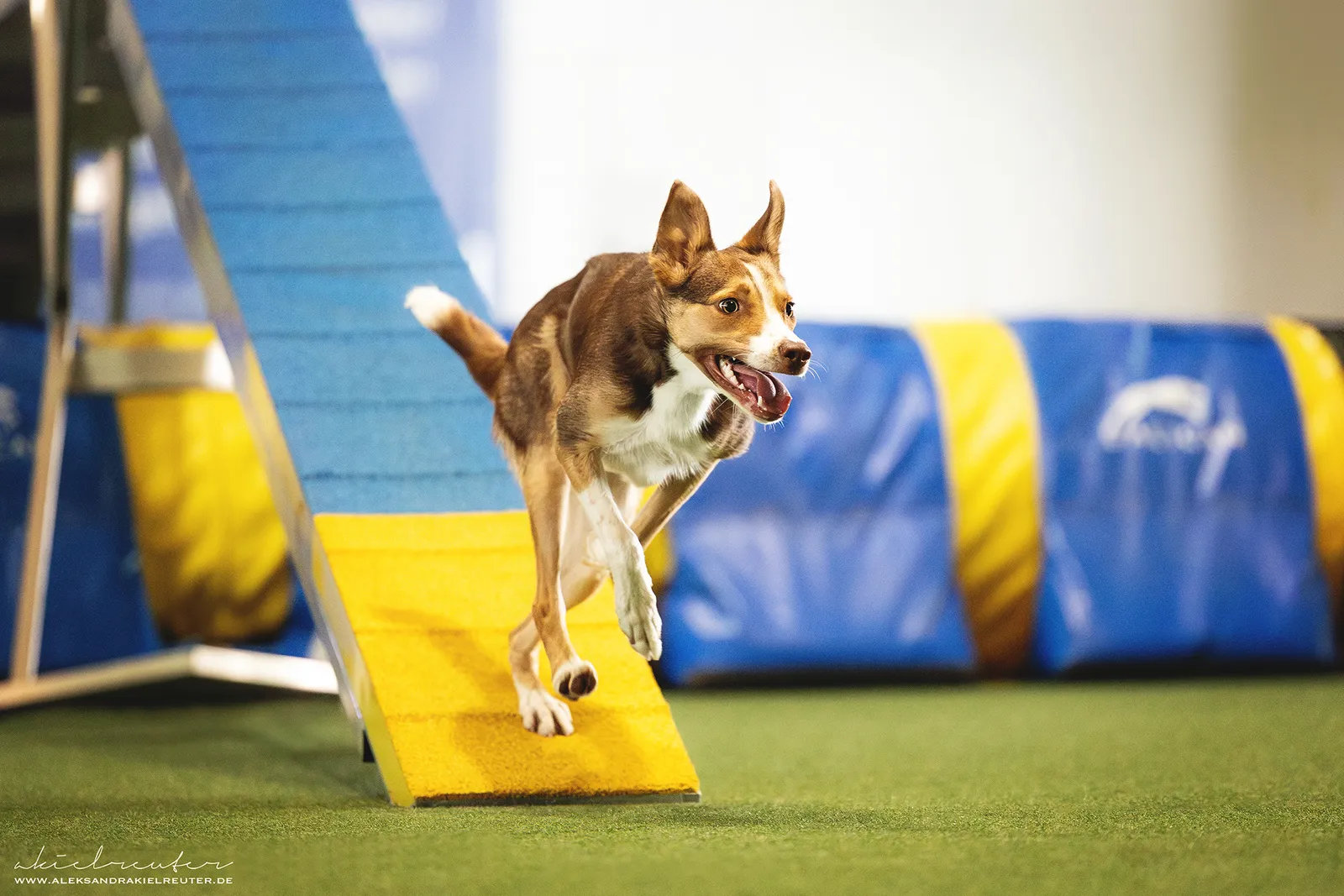
Fuze gave me a good example of this in weaves training. The technique through the poles was clean as long as the conditions were right. But as soon as a jump stood directly in front, a tunnel was nearby or we changed training grounds, Fuze missed entries or no longer recognized the weaves as such at all. The movement itself was mastered. But “weaves” as an independent obstacle to head for in any situation wasn't stored yet.
By the way, this isn't automatically a warning sign. Some fluctuation is part of the normal learning process: a skill that works at home but not yet elsewhere, or a dog that takes longer than expected with a particular skill. You're more likely to need to adjust something if there's no visible improvement for months, if your dog is getting steadily worse at a skill instead of better, or if clear signs of stress show up. The difference lies in the pattern: steady progress is good, even if it's slow.
A second building block explains a lot: training alone isn't enough. Your dog also needs time without training to consolidate what it has learned. Motor learning is transferred from short-term memory into long-term motor memory, and this process happens mainly during rest and sleep. What still looked shaky and halting in the evening can look much smoother the next morning, without any extra training in between.
This has an uncomfortable consequence for old training habits: motor learning has a saturation point. After about 15 to 20 repetitions of a complex movement, the brain needs processing time. If you keep practicing anyway, you're more likely to block progress than to help it.
What works instead:
If you ask for one more repetition after a good attempt, you often risk the opposite of what you want. The next failed attempt overwrites the success before it had a chance to settle.
This pattern also explains why a skill that's reliable in training can still fail in competition. A psychological model from learning research describes four stages that every skill goes through:
Stage 1: Unconscious incompetence. The dog doesn't yet recognize the obstacle or the skill as a task of its own. It doesn't know that it doesn't know.
Stage 2: Conscious incompetence. The dog tries, but still fails often. Effort is visible, success is inconsistent.
Stage 3: Conscious competence. The skill works reliably as long as conditions are familiar and the dog can give it its full attention. It knows the skill, but still has to think about it.
Stage 4: Unconscious competence. The skill runs automatically, even with distractions, under stress or in a new environment.
Most handlers consider a skill finished as soon as stage 3 is reached. Cognitive Load Theory offers an explanation for this: the brain has limited processing capacity. In stage 3, the skill still takes up most of it. Add stress, distraction or a new environment, and there's no capacity left for the actual execution. Only in stage 4 is the skill so automated that it holds up under pressure. And this very automation is also what makes it possible for flow to happen during a run.
This is exactly where most dogs get stuck. And this is where the most common handler mistake happens: as soon as a skill works reliably at home, it gets ticked off as done. The next challenge comes up, and the skill gets maintained on the side at best.
A skill that needs full attention to work simply has no capacity left when distraction, excitement or competition pressure come into play. The skill was never automated, so it falls apart under pressure. That doesn't mean your dog has gotten worse. It's simply still in stage 3.
You can build the path from stage 3 to stage 4 in phases that build on each other:
The rule here is simple, but hard to stick to in everyday life: if the skill fails in a phase, go back one step. Pressure only comes back in once the previous stage is solid again. If you respect this order, you end up with a skill that really holds. If you skip it, you risk exactly the moment in competition when the skill would matter most.
Before you keep working on the next skill, it's worth taking an honest look back. Pick a skill you consider “trained”. Does it only work at your usual training ground, or somewhere else too? Does it need your dog's full concentration, or does it also work on the side while your dog is distracted? What happens when a second dog shows up, an unfamiliar noise comes in or a stranger is standing on the field?
These observations show you more honestly than any training plan which stage your dog is actually in.
What Fuze showed me with the weaves and the contacts was always the same in the end: a skill that shines has reached a certain point of development, but rarely the final one. Knowing is the beginning. Doing also takes time, repetition in moderation and the right order.
This applies to every skill you build with your dog, from the very first foundations to competition. And it starts earlier than most people think, namely with how cleanly a skill is introduced from the start. A dog that learns from the beginning to understand concepts instead of just repeating movements will later find it easier to move through exactly these four stages, because it's used to really understanding instead of just functioning.
That's exactly where the Foundation Course comes in. It builds the foundation that makes every stage easier to move through later: attention, concentration, understanding concepts instead of merely imitating. If you build thoroughly here, you save yourself setbacks later.
And if, like with Fuze, it's specifically about the weaves for you: in the Skill Building: Weaves course, you build the entries step by step with the 2x2 method.
If your dog is currently stuck between “knowing” and “doing” with a skill, learning is happening right now, exactly the way it should. Give the process the time it needs, and observe closely instead of hoping. The rest will come on its own, sometimes literally overnight.
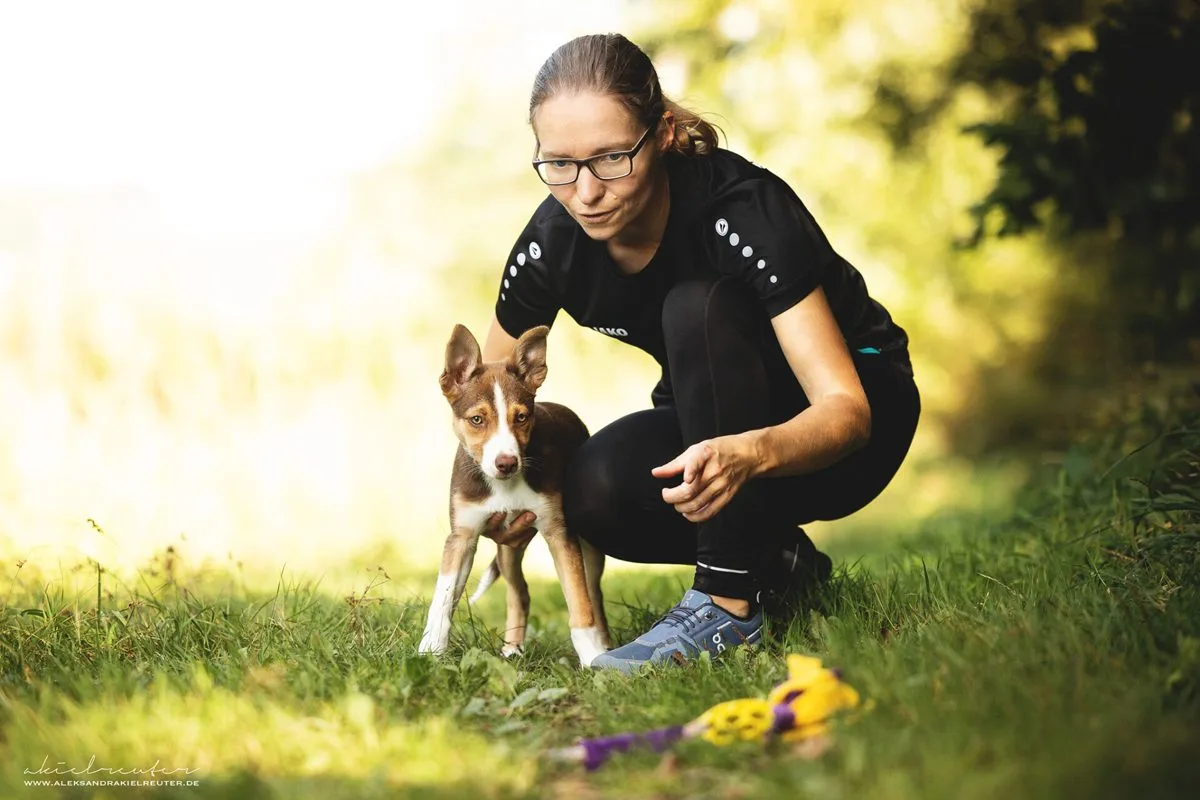
I have been running agility for 23 years and have been passing on my knowledge to other teams for 16 years. I studied psychology and e-learning, which is why my articles don't just explain what, but also why.
More about me →In the course library you will find the right training plan step by step, with video instructions and real corrections.