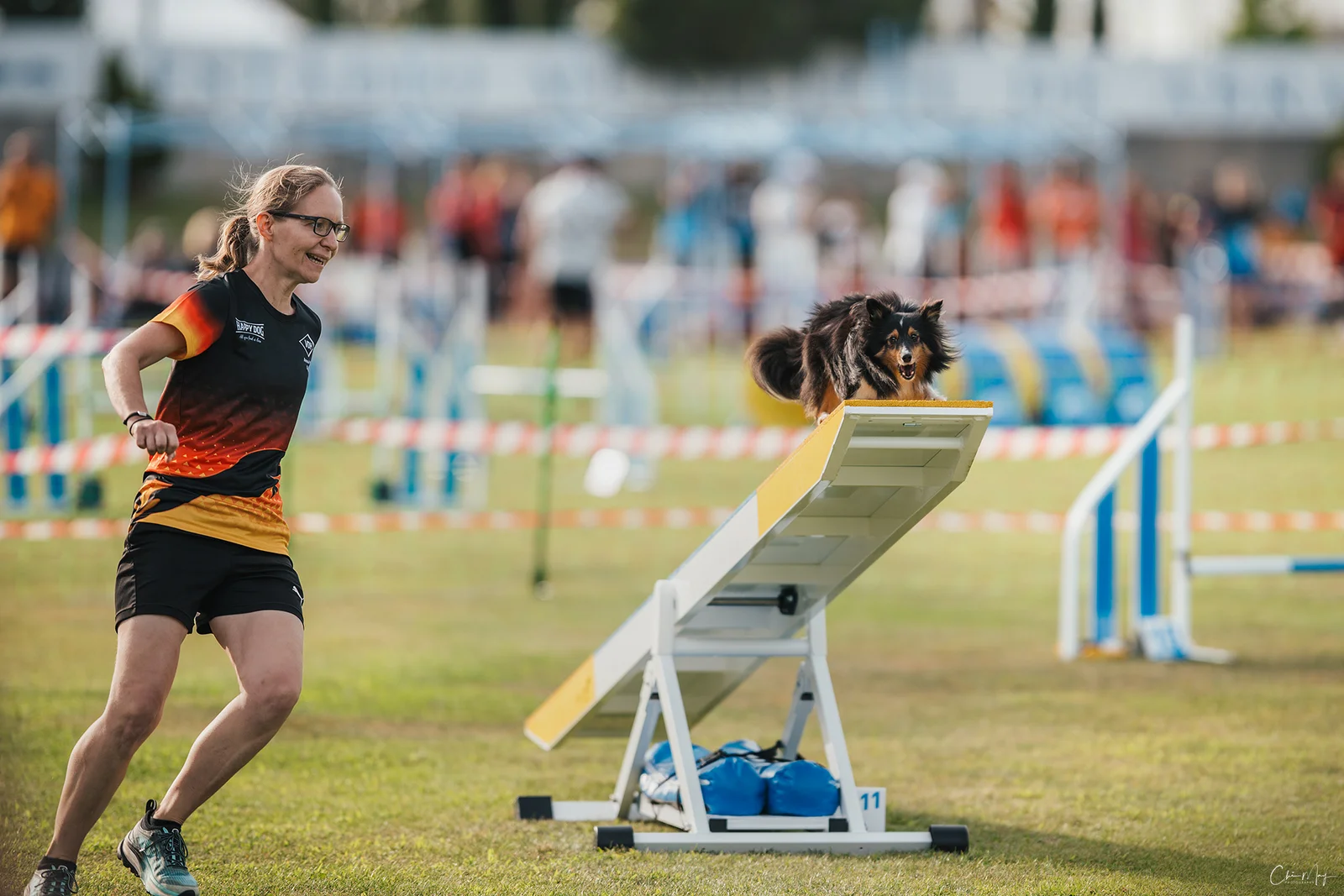
Your dog runs through the weaves, takes every jump, and at the seesaw they slow down. They bail off to the side or won't even step on.
The seesaw, or teeter, is one of the most technically and mentally demanding obstacles in agility. It moves, it's high, your dog has to balance, and at the end it bangs loudly onto the ground.
Often your dog experienced something at the seesaw that they couldn't predict: the board moved before they expected it, or it suddenly banged loudly. The seesaw is the obstacle where the ground really moves under their paws. If that movement comes as a surprise, the dog becomes insecure and avoids the obstacle next time.
Typical triggers I see in training:
You'll find the detailed solutions to these mistakes in my article Seesaw Training: The 5 Most Common Mistakes.
Sometimes the fear comes without any obvious mistake. My Border Collie Fuze developed a fear of the seesaw after her first heat.
If your dog suddenly becomes insecure at the seesaw even though it went well before, please first have a vet or physiotherapist check whether something hurts.
An insecure dog slows down at the seesaw, creeps towards the end, jumps off before the seesaw touches the ground, or doesn't hold their position until it has fully landed. Some dogs won't get on at all anymore.
In training you'll notice even subtler signs:
Ask yourself after every session: Does my dog stay relaxed? Do they look curious or rather cautious? Do they keep offering the exercise on their own?
Trust grows when your dog causes the movement and the bang of the seesaw themselves and can predict them. That's why I shape the seesaw instead of luring: your dog offers every step on their own, and you only go as far as they want to.
From a learning theory point of view, it's about the feeling of control. For your dog, it makes a big difference whether a movement happens to them or whether they make it happen. They should learn: "When I shift my weight, the seesaw moves." A predictable training environment creates predictable confidence.
This is how I approach the seesaw:
First, take a break from the seesaw. For your dog, it's now linked with insecurity. Build their confidence with exercises without the seesaw first, then return to the secured seesaw in small steps.
A client came to me because her dog had run over an unsecured seesaw at club training. It tipped under him, and he got such a fright that he didn't want to step on the seesaw afterwards. With a clear system, lots of patience and step by step on the secured seesaw, he rebuilt his trust in the obstacle.
For this, I put together five exercises that are emotionally neutral. Your dog trains the skills they need on the seesaw without having to step on the obstacle.
I'm happy to give you the videos for the first two exercises for free. Sign up here.
Keep every exercise neutral or positive and never ask for more than your dog can confidently show right now. Confidence comes from many successful experiences, not from making your dog overcome their fear.
With Fuze, when she suddenly showed fear, I paused seesaw training for two months and then focused on the bang game. The more energy I put into training, the sooner she got there. It was two steps forward and one back, and in the end she overcame her fear. Training with lots of distraction in a trial atmosphere also helped her, because her drive was higher there. But that depends a lot on the dog.
Setbacks are part of it. Then go back one step, to the height where your dog felt safe.
With every new seesaw, take a few steps back and show it to your dog calmly before you build it into a sequence. Just because they can do one seesaw doesn't mean they can automatically do every seesaw. I explain why in Knowing vs. Doing.
At the first trials, I only let my dog run over seesaws they already know. If possible, I come to the field beforehand and show them the seesaw. I avoid old, wobbly models completely. My priority is always: confidence first, then speed.
If you want to go this way step by step, you'll find it in Bang It, my seesaw class. The first exercises don't need a seesaw at all, and for every lesson there's a Fuze lesson where you can see how I worked with her fear, including the setbacks.
At what age can my dog start on the seesaw?
I start the actual seesaw training at around 12 to 14 months. By then the growth plates are usually closed, and joints and muscles are developed enough to absorb the strain of the tipping and the landing.
Should I lure my fearful dog onto the seesaw with a treat?
No. A dog who follows a treat and then gets startled because the seesaw suddenly tips or bangs will become more skeptical of it. Let them offer every step voluntarily.
May I hold the seesaw so it tips more slowly?
Better not. Your dog should cause the movement themselves. Instead, use a stable setup under the board, so the seesaw only drops a little and then rests securely.
How long does it take until my dog is no longer scared of the seesaw?
Your dog decides. Some need many sessions to relax in a new situation, others gain trust right away. Rather take more time than too little. Working through a bad experience takes much longer.
2on2off or 4on for an insecure dog?
For small, light dogs I clearly recommend 4on (all four paws stay on the seesaw), because the rebound of the seesaw in 2on2off (hind paws on the seesaw, front paws on the ground) can be uncomfortable. For sensitive dogs who still meet old seesaws at trials, I also tend to recommend 4on.
I have been running agility for 23 years and have been passing on my knowledge to other teams for 16 years. I studied psychology and e-learning, which is why my articles don't just explain what, but also why.
More about me →In the course library you will find the right training plan step by step, with video instructions and real corrections.