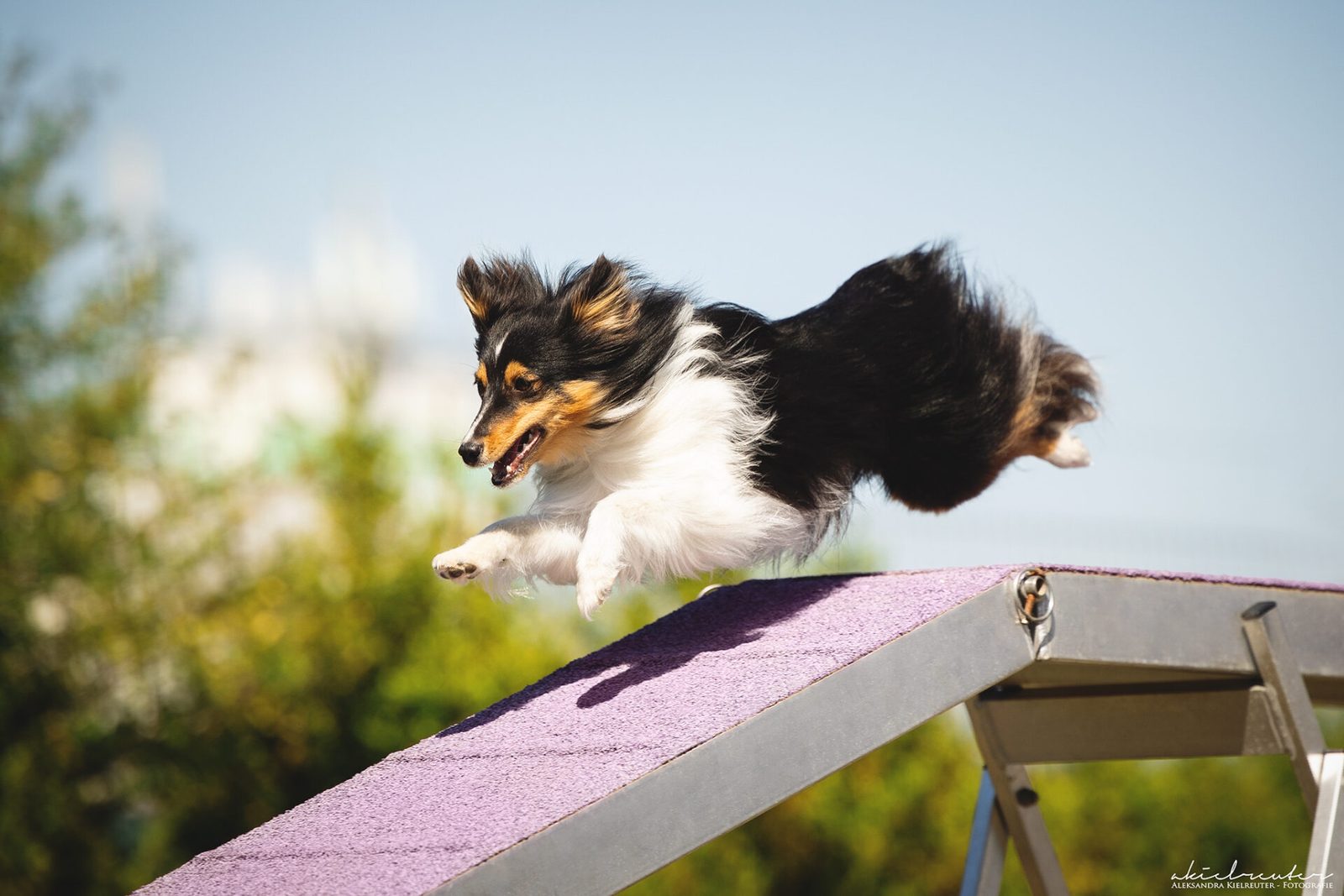
The first start in agility is an exciting moment for every dog and handler! In Germany, the first start is possible from 18 months. Here we have the A0 class, in which some special features await dog and handler. In A0, obstacles such as the seesaw and the weaves are not yet included, but all other obstacles can appear. A second chance run is also common, where you run the same course a second time instead of a jumping. Sometimes a jumping zero is offered as well. To move up to A1, you need at least three clear rounds in A0 (in the first chance).
When is the dog ready for the first start? Probably every agility handler asks this question. It is important that your dog has mastered all A0 obstacles and has already gained experience with the dogwalk and the A-frame in different environments. Ideally, your dog has already become familiar with the model that will be used at the competition.
For the perfect preparation for these obstacles, I offer my Run It: Dogwalk Class and the Bounce It A-frame course (course in German), in which your dog is introduced to the dogwalk and the A-frame in a targeted way and in small steps, so that it learns to understand both obstacles perfectly. Your dog should also be able to focus on you and not be overly distracted by other dogs or the environment. Sufficient socialization and the ability to feel confident in the competition environment are also crucial.
Full concentration even with lots of distractions
What goals and expectations should you have going into an A0 course? For many, the goal is to show the performance from training in the competition environment, too. This means your dog should be able to wait at the start, hit the contacts and respond to the jump cues exactly as in training. If certain cues are not completely reliable yet, it is advisable not to ask for them at the competition and, if necessary, to accept a less efficient turn or a “calmer” start. Having realistic expectations and not overtaxing your dog is the key to avoiding frustration.
It is important that your dog understands the competition as a natural part of the training process. If your dog notices that different rules apply at the competition or that you are less consistent, this can lead to insecurity. Instead, the competition should be seen as an extension of the usual training environment: a place where what has been learned is applied under new but controllable conditions. The first starts offer the opportunity to test how well your dog can apply what it has learned in training in a new environment. If you use the competition as a training opportunity, your dog will go to the start with the same confidence as in training.
The start should be solid at the competition, too
Choose your competition with care. Especially for the first start, it is advisable to choose a competition in an environment where your dog has already been able to train. This could, for example, be the competition hall that you rent several times for training, so that your dog can get to know the obstacles and the atmosphere.
An outdoor competition at a club where your dog has trained before is also a good choice. It is also important to be aware of how big the competition is. If you have a rather reserved dog, it is advisable to start at a smaller competition first, so you don't overwhelm your dog with too many distractions. Indoor competitions with a fenced-in course, which offer fewer distractions, are also a good option here.
Competitions with second chance runs are a particular advantage for the first start. They offer the opportunity to improve mistakes from the first run right away. A second chance run is also a great opportunity to try out a different handling or to test a cue that you may not have dared to use in the first run. For unsure dogs, the second chance run also offers the chance to already know the course, which gives these dogs more security and confidence. The handler often runs more relaxed and freely as well, which has a positive effect on the dog.
With these tips and a well-considered approach, the first start in agility will be a positive experience for dog and handler! Good luck with your first starts and have a great time in agility!
I have been running agility for 23 years and have been passing on my knowledge to other teams for 16 years. I studied psychology and e-learning, which is why my articles don't just explain what, but also why.
More about me →In the course library you will find the right training plan step by step, with video instructions and real corrections.