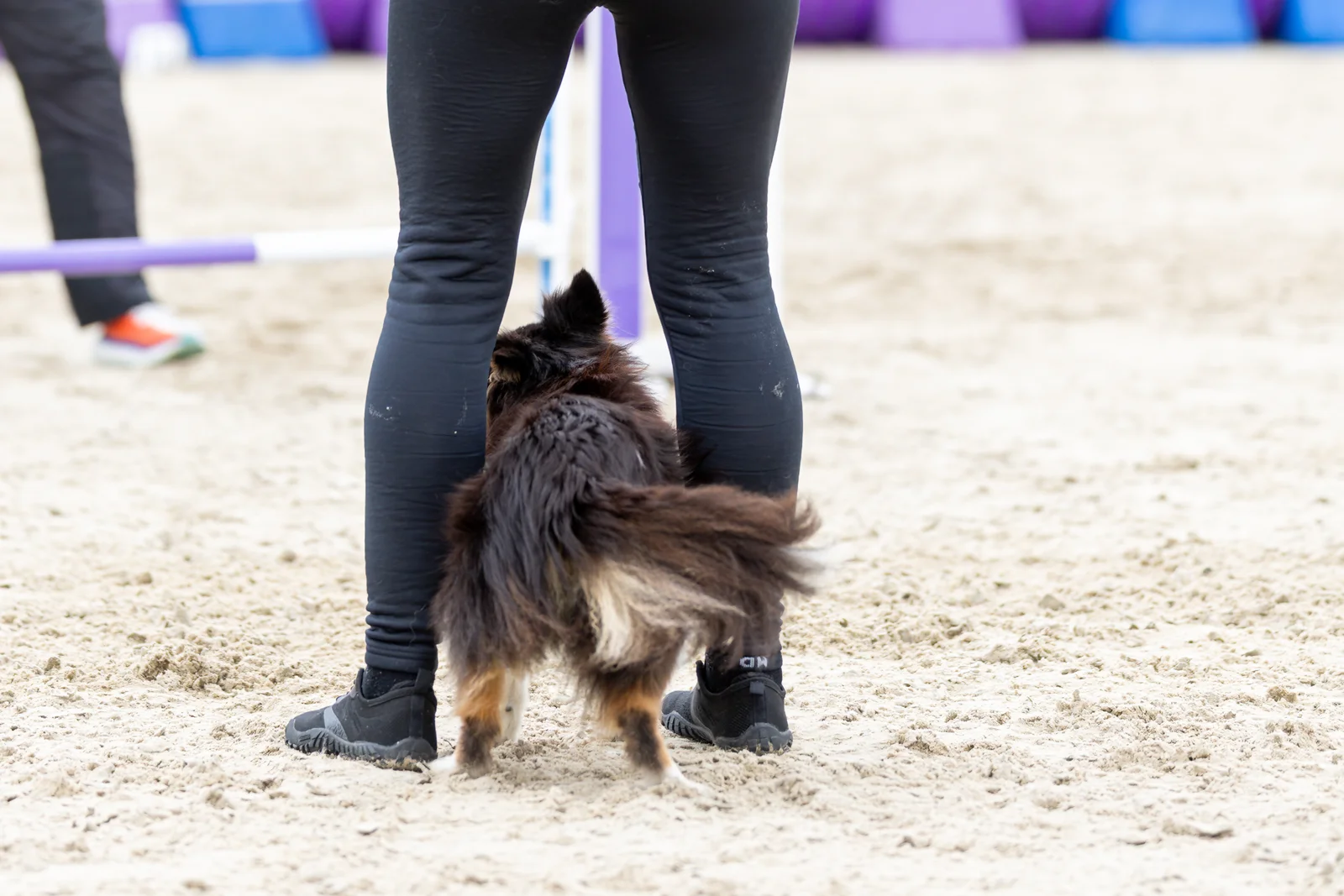
You set your dog up in front of the first jump, turn around, take two steps, and they're already gone. Or they creep after you, inch by inch. Or they stay sitting, but sniff the ground and barely get going when you release them.
That's how it was with my Sheltie, Move: she crept after me at the start line and couldn't stay lying down calmly, because she was constantly expecting that we'd go any second. Sometimes she simply took off.
Different dogs can have different start line problems, each for a different reason. That's why the usual "stay, stay, stay" so rarely helps.
Because breaking the start line pays off for them in that moment. It's never random: either it releases tension, ends boredom, or takes the pressure out of a situation that feels uncomfortable. Which reason applies to your dog decides what you train.
A little bit of learning theory: behavior is shaped by what happens afterwards. The mail carrier rings the bell, the dog barks, the mail carrier leaves. The barking worked without you doing anything. The start line works the same way: if the run follows the early start, it paid off.
A few mistakes I see in training again and again:
Most dogs fit one of three profiles: over-aroused and amped up, confident but low on motivation, or insecure. Many show more than one profile, depending on the environment, trial pressure and their learning history.
How you recognize them: They fixate on the course, bark, bounce, tremble or creep forward. They explosively release themselves, even though they actually understand the exercise.
Why breaking the start line pays off for them: Movement releases tension instantly, and they get what they want most: action. With this much arousal, the anticipation is bigger than their ability to regulate themselves.
What helps them: real impulse control under arousal, lots of testing of the exercises, and environments that become more exciting step by step. Once they understand the waiting, clear and fair consequences come in.
How you recognize them: The position is right, the energy is missing. They react slowly to the release, show little anticipation, and are more likely to leave the start to sniff or wander off.
Why breaking the start line pays off for them: They escape a boring moment and get things moving. Often the release is unclear to them or doesn't mean anything valuable.
What helps them: less impulse control, and instead a release that makes them really want to run, in short sessions with lots of play.
How you recognize them: They hesitate, freeze, sniff or quietly leave their position. Noise, the environment or pressure get to them.
Why breaking the start line pays off for them: It reduces pressure, creates distance from something unpleasant and gives them control over the situation. Waiting makes them more insecure instead of more confident.
What helps them: trust and safety first. Small steps, new environments early and regularly, and difficulty raised slowly. On top of that, you build a safety anchor that gives them something to hold on to at the start line.
The Traffic Light System splits the start into three phases: red means waiting without pressure, orange means focus, green is the release. Your dog no longer has to guess when they're allowed to go, and you have time to calmly get ready for your run.
Here's an example from my Startline Bootcamp:
🔴 Red: waiting without pressure. Red starts as soon as you've set up your dog and walk away. They don't have to be tense and staring at the first jump, waiting calmly is enough. You walk to your position, check that you're standing right, and take a breath. You don't need to manage your dog while you do this. For them, red means: nothing is expected of me yet.
🟠 Orange: focus. Now you signal that it's about to start. You raise your hand and build body tension. If you have a focus cue, this is exactly where it goes. Your dog turns their attention to the first jump, but stays in position.
🟢 Green: the release. My cue is "okay". Because red and orange were predictable, the release becomes fast and powerful.
The long phase while you walk away is no longer a stressful phase. The tension only starts with orange, and orange always comes before they're allowed to go.
Your dog also learns where a behavior applies. A start that's rock-solid in your living room isn't generalized yet, because every new environment changes arousal and expectations.
That's why I work with an Environment Ranking. You list ten places, from your living room (level 1) through your yard, an empty parking lot, a busy park and the area outside an agility hall, all the way to the warm-up jump (level 9) and a real trial start (level 10).
You train at the level where your dog succeeds reliably, and only move up once the start is calm and stable there. If it falls apart, you go back one level. Your dog is giving you information and isn't failing when they make mistakes.
Your free Environment Ranking: With this worksheet from my Startline Bootcamp, you rank your own training locations from level 1 to 10. Get it for free here.
I build a new one. The old start is a whole pattern full of emotions and expectations. As long as the routine looks, sounds and feels the same, your dog brings the old behavior along.
The start is a behavior chain: you enter the ring, your dog gets into position, holds it and gets released. If one link is unclear, the whole start wobbles. Typical patchwork: the dog is supposed to lie down, they sit, you say "down" five times, and in the end you start anyway. That won't get you there.
For the new routine, you change as many elements as possible. You'll find out exactly what that looks like in the Startline Bootcamp.
Training happens away from the equipment first. Every early mistake strengthens the old behavior.
Only once your dog has really understood the new behavior. Until then, you reward a lot and train as error-free as possible. A correction doesn't explain a behavior, it only tells your dog: this choice didn't lead to success.
A correction is never loud and never emotional for me. It's clear, immediate and fits the dog in front of you. For an insecure dog it's much milder than for a very driven, confident dog.
If you rebuild the start with a well thought-out system, the number of corrections at trials stays small. But if the problem already showed up at trials, you may have to sacrifice one or two trials. That's how it was with Move: at the very first trial after the rebuild, I had to enforce the rule exactly once and give up the run. After that, her start held.
In the Startline Bootcamp, you build this step by step with videos, in four modules, from reward markers through the new routine and the Traffic Light System all the way to the trial. All you need is one jump.
Should I tell my dog "stay" at the start line?
Once at most. I don't say stay at all. I train an automatic stay: on sit or down, my dog holds the position until I release with "okay". Constantly repeating "stay, stay" while you walk away only puts pressure on your dog.
Sit, down or stand at the start line?
I recommend sit or down. In a stand, it's often hard to see when your dog is cheating, and that makes it difficult to respond fairly later on. If you're building a new start, choose the position they haven't used before.
My dog stays in position but barely starts. What can I do?
Then the release needs more energy: run away while your dog is still waiting, and only release once you're already moving, so they chase after you.
How long does it take to build a new start?
In the Startline Bootcamp, I plan for 4 to 6 weeks of training. Often there are around 2 months of training between the old, restless start and the first calm trial starts with a new cue. Work on each level until it feels easy.
I have been running agility for 23 years and have been passing on my knowledge to other teams for 16 years. I studied psychology and e-learning, which is why my articles don't just explain what, but also why.
More about me →In the course library you will find the right training plan step by step, with video instructions and real corrections.