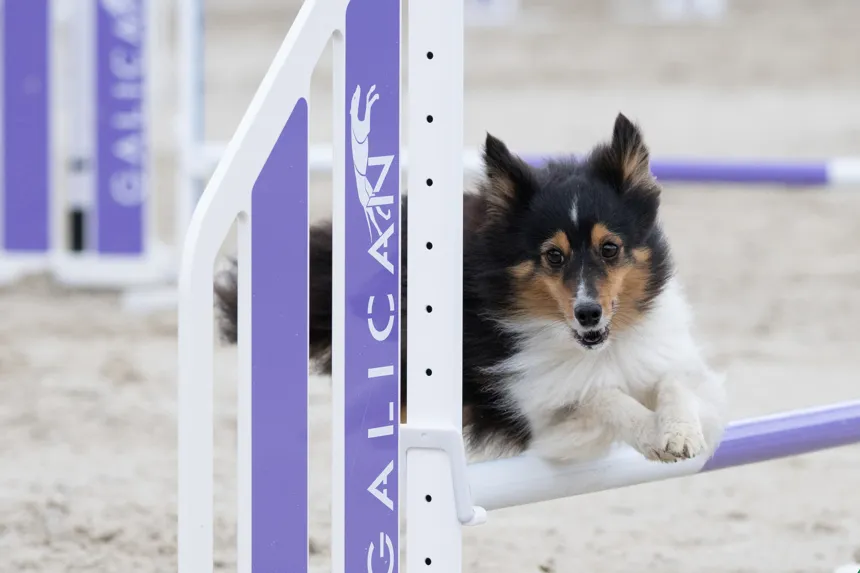
The same exercise has been on your training plan for months. And for months, the same thing has happened: it doesn't quite work. You've tried variations, done more repetitions, stayed patient. At some point a thought creeps in that feels almost like relief: my dog just can't do this. It's simply its limit, its build, its way of running or thinking.
This thought feels like acceptance, like realism. But most of the time it doesn't answer the real question: whether an actual limit of ability has been reached, or whether the method meant to teach this ability was never quite clear.
Psychologist Carol Dweck of Stanford University studied exactly this difference for years, first in classrooms rather than in dog sports. She observed how children react to challenges and failure, and found two fundamentally different ways of thinking.
In a fixed mindset, the basic assumption is: abilities are fixed, innate traits. You either have them or you don't. A failure is then read as proof, as confirmation of a limit that's simply there. In a growth mindset, a different basic assumption applies: abilities develop through effort, the right strategy and feedback. Here, a failure mainly tells you something about the current method.
Dweck herself later clarified that a misunderstanding is going around. Growth mindset doesn't simply mean practicing more or staying blindly optimistic. It's about how you react to a setback: is the problem the ability or the strategy?
The fallacy that makes fixed mindset thinking so persistent is subtle. Failing again and again without changing strategy feels like proof. You try something for the tenth time in the same way, it doesn't work again, and the supposed limit seems confirmed. But all that's confirmed is that one method didn't work ten times. It says nothing about a real limit.
I know this moment well, because I lived it myself for years. Tight turns were a construction site with Move for years, and nothing moved. The soft turns were beautiful, but as soon as a turn had to be tight, there was no collection. Collection here means: the dog gathers its center of gravity just before the turn, shortens its strides and becomes more compact before taking off. Instead, Move rushed into the turn at full speed, flew wide and lost time and the perfect line.
For a long time I thought this was simply Move's movement pattern, a limit I'd have to accept. So I practiced more: more repetitions of tight turns, more sequences, hoping the pattern would eventually sink in on its own. It didn't sink in. That was never the real problem.
The wrong conclusion this story could easily lead to: just keep at it, repeat more, it'll work eventually. That exact conclusion led me into a new trap with my Border Collie Fuze.
Psychologist Anders Ericsson spent decades studying how experts in all kinds of fields actually get better. His key distinction: naive practice versus deliberate practice. Naive practice means doing something over and over, hoping that improvement will come on its own. Deliberate practice means working purposefully at the edge of your own ability, with a clear focus on the specific mistake and with immediate feedback on it.
This difference has a neurological basis. When a movement works well enough, the brain starts to automate it. This process takes place mainly in the striatum, a part of the basal ganglia that stores repeated sequences of action as routines. Once something is stored there as a routine, activity in the prefrontal cortex drops, the area responsible for conscious control and error correction. The brain saves energy and repeats the existing routine, even if it contains a mistake.
Real correction needs a different network: the anterior cingulate cortex, ACC for short, responsible for conflict monitoring. It detects deviations from what you actually intended and becomes active when attention is directed specifically at a mistake. With pure repetition without this focus, it largely stays out of the picture, and the faulty automation becomes even more ingrained.
This explains my training block with Fuze at weave entries after tunnels pretty precisely. For weeks, the same combination, tunnel, weaves, tunnel, weaves, firmly convinced that this was growth mindset in action. The error rate stayed about the same over the weeks, on some days even a little worse. Every repetition just gave the existing routine in the striatum more opportunity to become ingrained. Only when the exact moment of the mistake was isolated and the sequence was varied deliberately, a short tunnel, a slower approach, then gradually increased, with a short reflection after each session, did something visible change within a few weeks.
A third mistake turned out to be just as persistent: accepting constant failure as a training strategy because it's supposedly part of the process.
Carol Dweck likes to tell the story of a school in Chicago that had introduced an unusual grading system. Students who didn't pass an exam didn't get a “Fail” grade there. The result was called “Not Yet”. This small difference shifts the focus from a judgment about ability to a statement about timing.
A few phrases and behaviors that typically point to fixed mindset thinking in your own training:
Real limits do exist, though. Age, health and individual physical conditions are real factors that need to be respected, especially in a sport where joints and structure matter so much. The difference lies in the reasoning. A physical limit can be named and discussed with a vet or physiotherapist. An unclear method has so far only been repeated more often, without anything about it changing.
With an exercise that hasn't made progress for months, take a second look at the method before passing judgment on your dog. This applies to tight turns just as much as to weave entries or completely new cues. If you want to work on clean weave entries with the 2x2 method, you'll find a clear, step-by-step structure there, exactly the kind of clear criterion that made the difference in the story with Fuze above. And if, like Move, you've been struggling with tight turns for years, it's worth taking a look at Skill Building: Left & Right: a course that teaches the concept of Hard Turns clearly and step by step.
With Move, it became clear over time that the turn was never the limit. The missing piece was a clearly defined criterion for collection. With Fuze, it was the missing focus on the one moment in the sequence where the mistake actually happened. Two different dogs, two different construction sites, the same thinking error at the start: a judgment about ability was made before the method was really questioned.
The next setback in training is sure to come. The question worth asking then isn't whether your dog can do it. It's whether you've shown it clearly enough how.
I have been running agility for 23 years and have been passing on my knowledge to other teams for 16 years. I studied psychology and e-learning, which is why my articles don't just explain what, but also why.
More about me →In the course library you will find the right training plan step by step, with video instructions and real corrections.