You pick up the leash. Not a word said, no door opened, not a single step toward the car. And still: your dog turns around, ears go up, the whole body gets excited.
Maybe you know this from the training bag you just take out of the cupboard. Or from the sound of your car keys. Something in your dog reacts before you've even done anything. The obvious explanation would be that your dog is simply attentive, clever, well trained. The real explanation is less spectacular and at the same time more interesting: it's a mechanism that runs practically automatically in any brain that has been trained long enough, in dogs just as in us humans.
This mechanism has a name: the habit loop.
The term comes from behavioral research and describes how repeated behavior turns into something automatic. Three elements work together.
Cue: a trigger that announces the situation. For Move, it's the leash in my hand.
Routine: the action that follows the cue. With Move, this shows up as physical arousal, focusing, getting ready.
Reward: the reinforcer that closes the loop. In this case: going out, training, doing something exciting.
On the behavioral level, this sounds simple. It gets interesting when you look at what's happening in the brain at the same time.
When a behavior is new, the prefrontal cortex is involved in the decision, the area right behind the forehead responsible for conscious weighing and control. A young dog seeing the leash for the first time first has to make sense of the situation. That costs processing capacity.
If a connection is repeated often enough, control shifts toward the basal ganglia, a group of nuclei deep in the brain. The striatum in particular is considered a central hub for automated patterns of action. Once a sequence is firmly wired there, it runs with much less cognitive effort. That saves energy: if your brain had to think through every recurring action from scratch, you'd be exhausted all the time.
For a long time it was thought that dopamine is released mainly as a reward after a successful action. More recent research shows something different: once a connection has been learned, the dopamine release moves forward, right to the cue. That's why the excitement is already there at the sight of the leash, long before the actual training starts. Move isn't consciously putting anything together here: the brain has long been anticipating the reward the moment the cue appears.
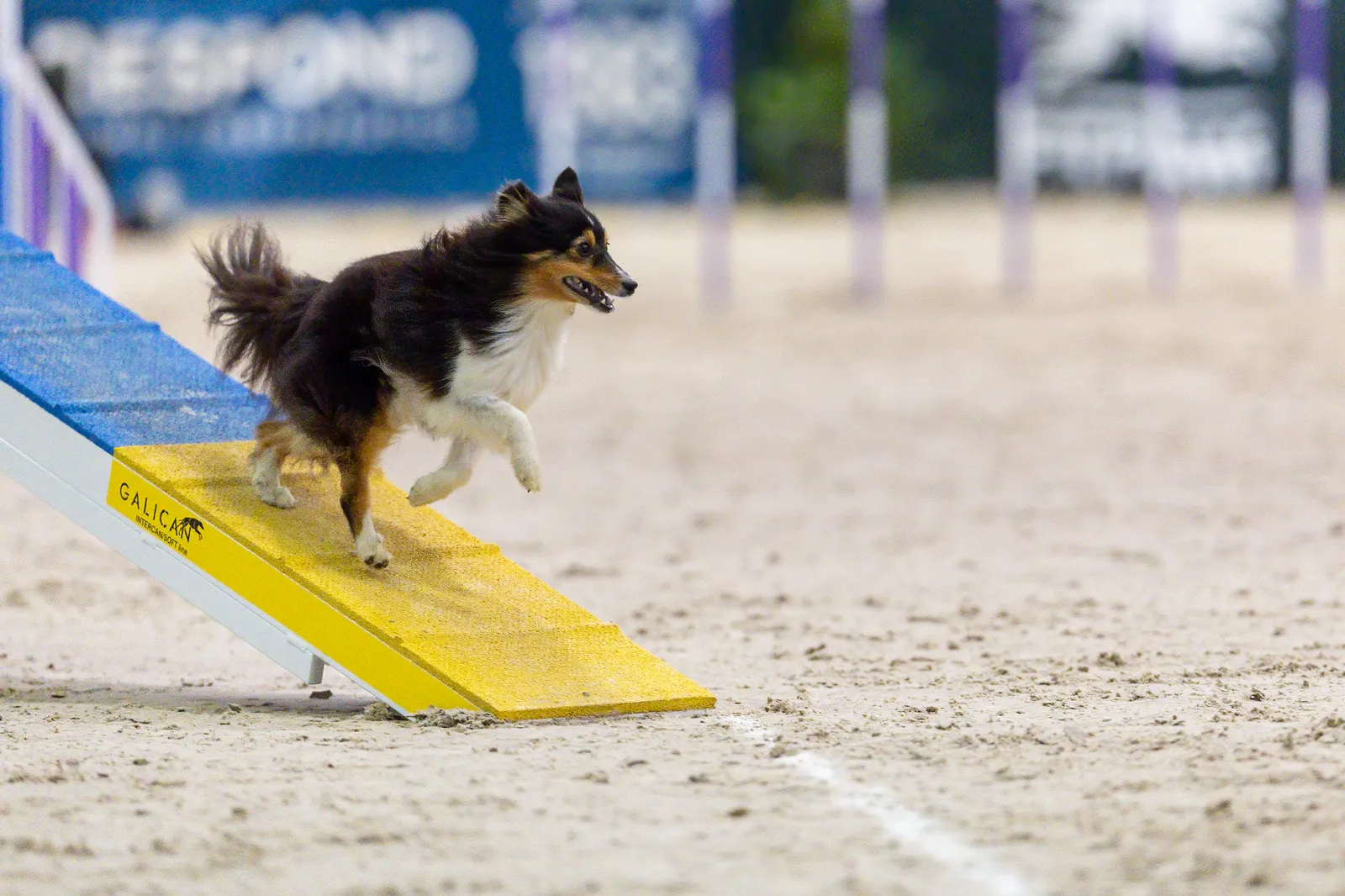
Move is on the seesaw, in the waiting position, like a thousand times before. I take a brief look before I move on and give the release. I've been doing this for years, in every training session. I never noticed it. After all, it works: Move releases reliably, exactly when I say so.
At least that's what I thought. Only at the European Open did I realize what Move is really reacting to: the moment my gaze moves away. My moving on itself hardly matters.
Over months, a fixed chain had formed: my look at Move, looking away, and right after that the release. I never trained this order. It crept in because I repeated it the same way every time. For Move, the end of eye contact became the reliable signal.
This is called unintentional cueing: a dog learns any behavior that repeats reliably enough, including signals nobody trained on purpose. Our own body language constantly creates cues that no handler planned.
It only became visible when the routine was broken. At the EO, unlike usual, I stood exactly level with Move instead of standing off in front. As a result, my looking-away cue happened slightly shifted. Move hesitated, half fell off the seesaw, seemed confused, waiting for a signal that had long become a prerequisite, even though I had never consciously taught it.
Unintended cues like these are probably hiding in your training too, tucked away in routines that simply feel right:
The simplest test: deliberately change one small detail in your usual sequence. A different position, a different angle of view. If your dog reacts confused or unsure, you've found your own unintended cue.
The habit loop explains why unplanned signals creep in. In the same way, it shows how a routine can be shaped consciously.
One example: the start area before a competition run. A sore spot for many dogs. Your dog waits, sees the dogs all around, and its attention drifts away from the handler toward the dogs on the course. Repeating a familiar cue like “sit” doesn't do much here, because a long-known signal hardly demands any attention. It runs almost on autopilot, and that autopilot is exactly the problem when the dog is already drifting off.
A short discrimination task is more effective: switching between two or three known signals in an unpredictable order. Hand target, another signal, hand target again, or left turn, right turn, hand target in between. Your dog already knows every element. Only the order is new. That forces your dog to really listen every second instead of slipping into waiting mode. The foundations for this are already laid in the Basics for Sport Dogs course.
With consistent repetition over several weeks, this changes more than the individual cue. The entire inner state linked to this cue shifts. The start area stops announcing waiting and drifting off. It becomes a signal for active attention.
How long this takes is hardly answered by the often-quoted figure of 21 days. It goes back to a misunderstanding of a book from the sixties and has little to do with sound research. The actual data paint a blurrier picture. In a well-known study by Lally and colleagues from 2010, automating a new behavior took more than two months on average, with a range from a few weeks to almost a year, depending on how complex the behavior was and how consistently it was repeated. With a simple, clearly defined routine like switching signals in the start area, you'll often see a clear change after just three to four weeks, even if full automation takes longer.
Two exercises follow directly from all this, whether you're currently working on an unwanted cue or a desired one.
First: find your own unintended cue. At an obstacle with a fixed waiting position, watch closely what you do just before you release your dog: your gaze, your posture, your tone of voice, your breathing. Then deliberately change one small detail and watch whether your dog reacts confused. That's often exactly where a signal lies that you never planned.
Second: choose a situation in which your dog often drifts off or gets restless, for example in the start area, during a waiting phase or in the transition between two exercises. Build in a short discrimination task there with two signals your dog already knows, and repeat it over several weeks, every time this situation comes up. Pay attention to your dog's entire state in this situation, not just to the individual response to a cue.
These two exercises don't need any new cues or complicated training plans. What matters is being aware that every repetition shapes a connection, whether you want it to or not.
The habit loop is running in your training anyway, constantly, in every session, with every dog. Cue, routine, reward form as soon as something repeats reliably enough.
That makes habits a reliable result of repetition, not a product of chance. And that's exactly what makes them something you can shape: through the conscious choice of which cue you set, which routine you build from it and which reward closes the loop in the end.
The next look you give your dog on the seesaw. The next moment in the start area before a run. In moments like these, a habit is forming right now, whether you're aware of it or not. At your next training session, take a close look at which one you're forming.
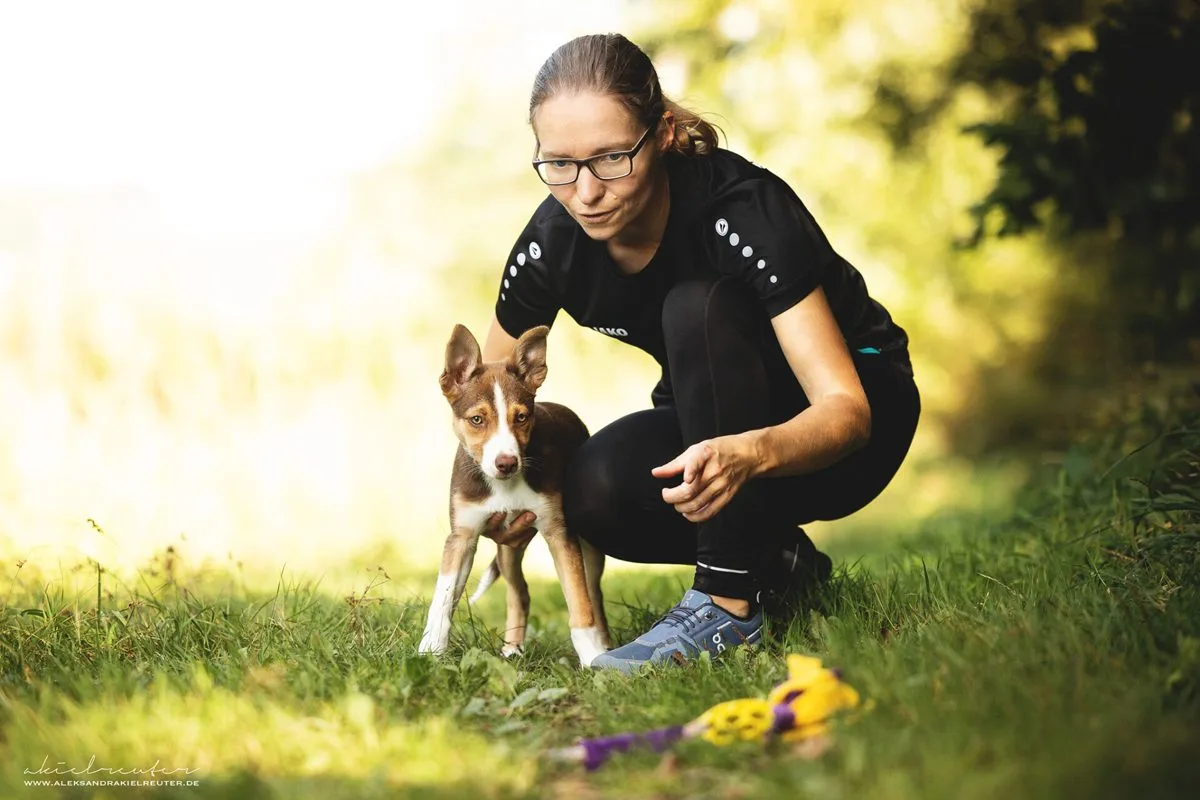
I have been running agility for 23 years and have been passing on my knowledge to other teams for 16 years. I studied psychology and e-learning, which is why my articles don't just explain what, but also why.
More about me →In the course library you will find the right training plan step by step, with video instructions and real corrections.